

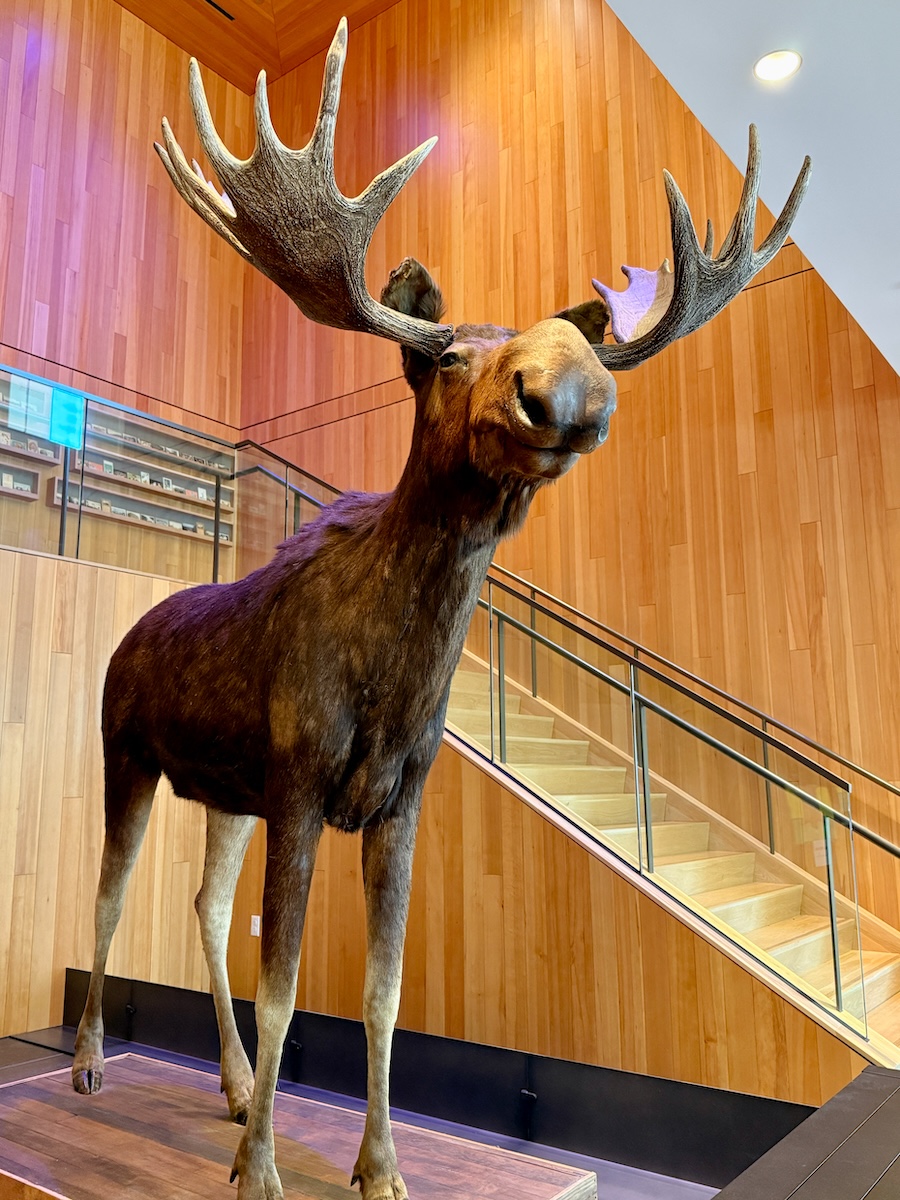
The first thing you see when you walk into the Corvallis Museum is a moose. Not a photograph of a moose. Not a painting of a moose. An actual, full-sized, taxidermied moose. His name is Bruce, and judging from the number of people who seem genuinely delighted to see him, he may be the most popular resident of Corvallis.
I grew up here. Or at least enough of my growing up happened here that the distinction hardly matters—from fifth grade through high school graduation. On paper, that doesn’t sound like very long. When you’re 11 years old and trapped in middle school, though, it felt like the entire Bronze Age.
By the time I graduated high school, my life plan consisted largely of getting the heck out of Dodge. I headed south to the University of Oregon, Oregon State University’s traditional rival, and never seriously considered moving back. Well, except for an accidental three-month return about nine years later. The less said about that, the better, though.
Corvallis isn’t a terrible place to be from. In fact, I suspect the places that shape us are often the places we’re most eager to escape. I knew it too well—every street, every neighborhood shortcut, every convenience store, and every reason I wanted to be somewhere else.
That was more than 40 years ago. Since then, Corvallis has settled into a comfortable role in my life. My parents still live there, along with several of my favorite people. Rick and I visit often enough that I can’t claim to have escaped. My relationship with the town remained largely unchanged since I left, though. I’m happy to visit the people. The town itself was incidental.
Which is why I was surprised to find myself genuinely interested in visiting the museum. Part of the appeal was simple curiosity. The museum opened in 2021 in a striking new downtown building, replacing the historical society’s older, less visible home in a basement beneath OSU’s basketball arena.
The other part was that local museums occupy a special category all their own. Major museums collect masterpieces. Small-town museums collect whatever generations of residents couldn’t quite bring themselves to throw away. When one of the four galleries is dedicated to Hats & Chairs, you know you’re not in Smithsonian territory.
And that’s not a criticism. Local museums aren’t built around masterpieces. They’re built around what they’re given. Nobody set out to create the world’s foremost collection of hats and chairs. They just woke up one day and realized they owned enough hats and chairs to justify a gallery.
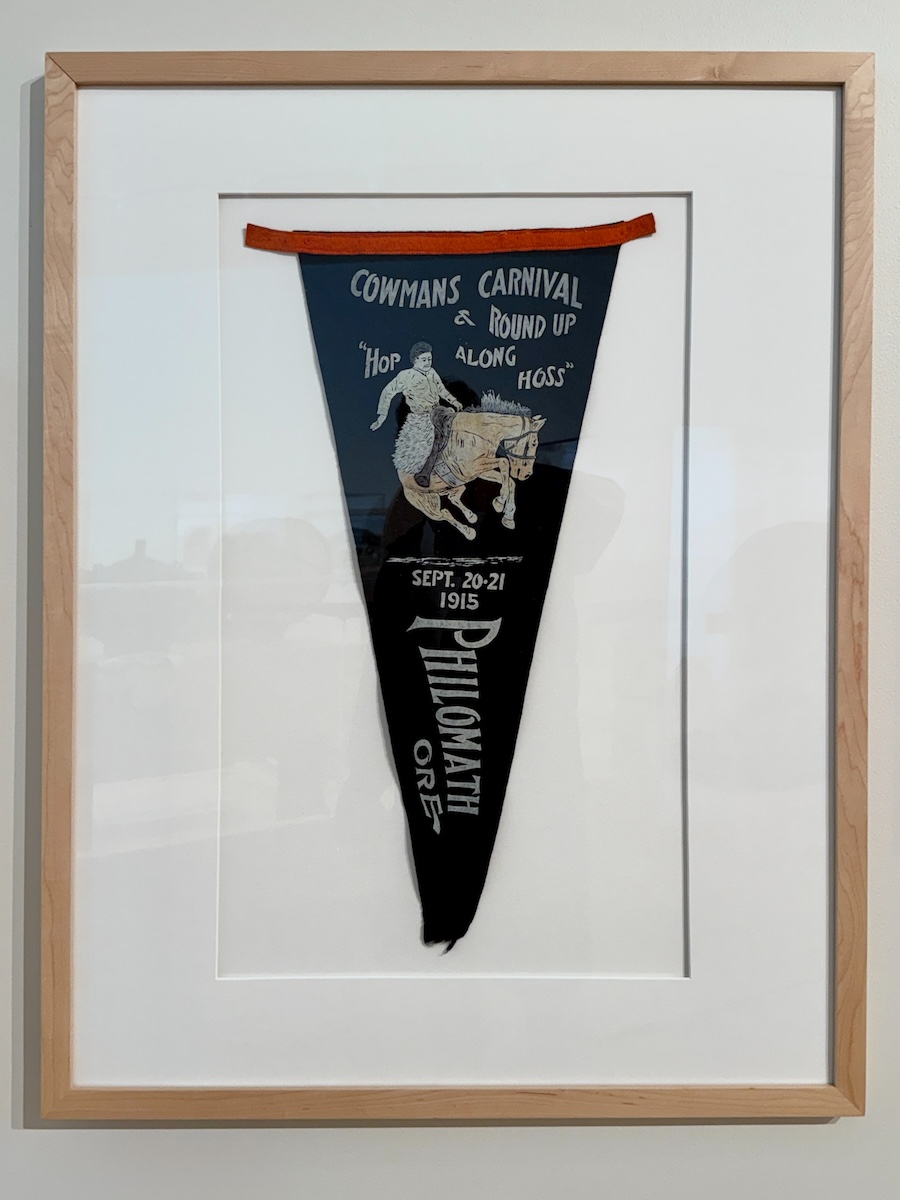
Beyond the hats and chairs, the Corvallis Museum contains old photographs rescued from attics, historic signs salvaged from long-defunct businesses, endless artifacts connected to OSU, and enough local memorabilia to keep a nostalgia buff occupied for days.
The strange thing wasn’t that any of it was here. Every town accumulates this sort of stuff if you give it enough time. The strange thing was realizing that, somewhere along the way, I’d become interested in it.
Bruce may be the museum’s unofficial mascot, but he isn’t its best exhibit. That distinction probably really does belong to the Hats & Chairs room.
The title tells you almost everything you need to know. One entire gallery of the museum’s four—so a quarter of the museum—contains a collection of, well, hats and chairs assembled from across Benton County’s history. Fancy hats. Practical hats. Miniature hats perched on dollhouse chairs. Large hats displayed beside large chairs. The museum treats it all with such complete sincerity that any inclination to laugh quickly gives way to admiration.
Major museums begin with a mission. They decide what story they want to tell and then build collections to support it. Local museums work the other way around. One family donates a photograph album. A business closes and sends its old neon to the museum. A beloved professor dies and leaves behind a collection. Over time, the whole thing grows until someone realizes it’s the community’s collective memory.
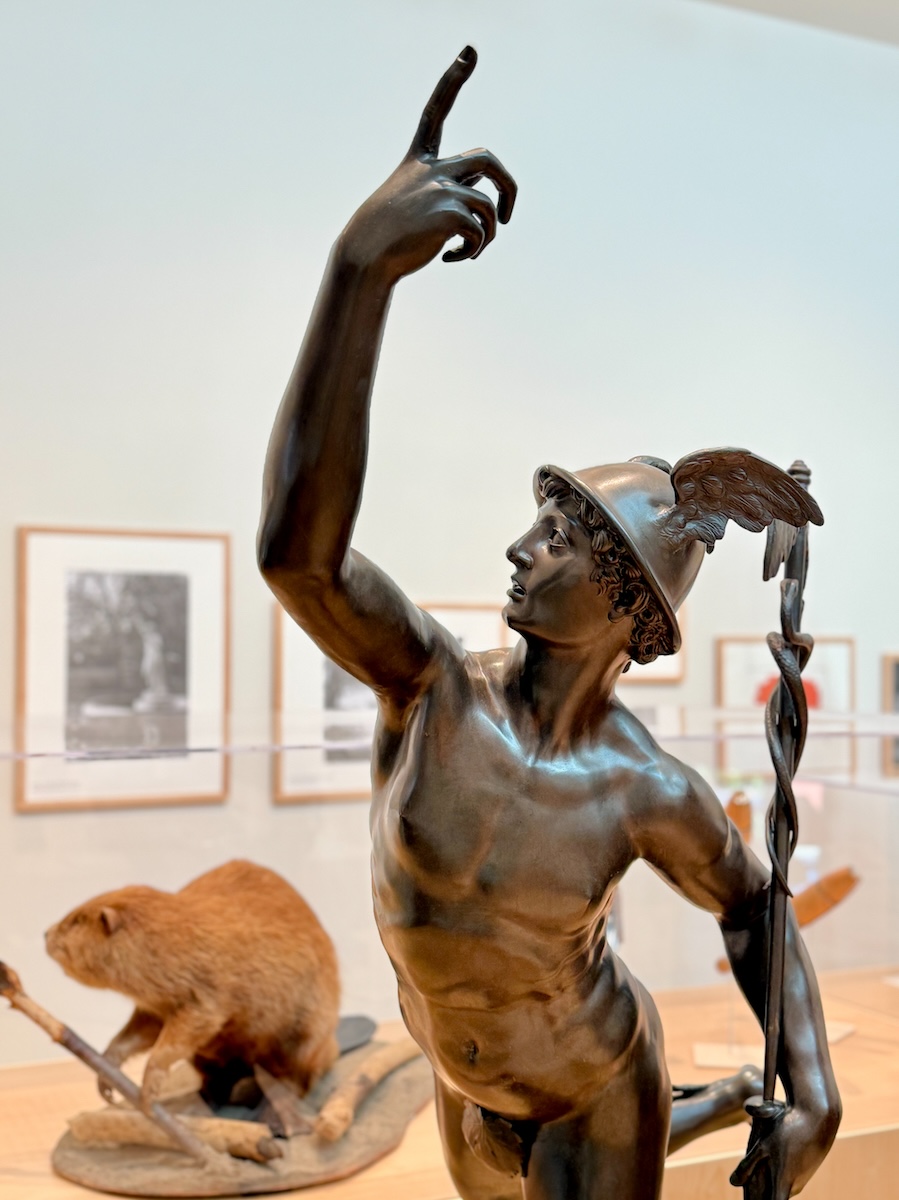
The Corvallis Museum embraces that reality. One minute, I was looking at a massive quilt celebrating Oregon State University. A few steps later I was admiring a bronze statue of Hermes sitting by a stuffed beaver. There were photographs of football games, drawings by local residents, and an unidentified little boy in a bonnet whose expression suggested he wasn’t entirely thrilled about the situation. That one is literally labeled "Unidentified Boy,” which begs the question—how do we know he’s even from Corvallis?
Sure, the individual objects felt a bit random. Taken together, though, they felt familiar. Corvallis has always occupied an odd space between college town and farming community, between academic ambition and practical common sense. The museum reflects that personality perfectly.
The building itself makes that contrast more striking. The museum’s modern downtown home is all clean lines, soaring spaces, and carefully designed galleries. Architecture critics have praised it since it opened. And yet, for all the attention paid to the building, Bruce the Moose still dominates the conversation. People stop by to photograph him. Children try to touch him. Visitors greet him on their way in like he’s an old friend.
Corvallis has spent generations producing researchers, engineers, scientists, and professors. It also remains a town perfectly capable of rallying around a dead moose. The museum honors both sides of the town’s personality.
One photo I almost walked right past was of the old Corvallis High auditorium, taken from the stage with row after row of empty seats stretching toward the balcony. For a high school auditorium, it was a surprisingly formal space, more of a small civic theater than an assembly room. I spent an embarrassing amount of my teenage years in that room. I could almost reconstruct the space from memory—where the stage doors were located, where my friends and I liked to sit for assemblies, what it smelled like. I also remembered Mr. Malango, who, when frustrated with a rehearsal, would throw his clipboard onto the floor and shout, “God bless the Chinese!”
Nearby sat the school’s original cornerstone, salvaged before it was demolished in the late 1990s. Its inscription dedicated the school to “the hopes and aspirations of youth,” which feels exactly like something adults would carve into a school building in 1935. Teenagers throughout history were more likely to think about lunch or Friday night’s game.
The shock wasn’t that I recognized these things. It was how much they mattered.
Elsewhere in the museum, I found an old aerial postcard showing Corvallis from above. The town looked impossibly small. Not just smaller than today, but smaller than the Corvallis I remembered. Streets ended abruptly. Neighborhoods that seemed established during my childhood hadn’t even been built yet. Huge parts of town were just open fields.
I studied that postcard like I’d study an old family photograph. The museum wasn’t displaying history in the abstract anymore. It was displaying versions of a place I had known, along with versions I had missed entirely. The distance between those two things turned out to be surprisingly small.
The museum was also a useful reminder that living somewhere and understanding it are not the same thing. At all. I grew up here, but I guess I never learned much about the town’s history. I never knew, for instance, that there’d once been a U.S. Army fort just west of town.
Fort Hoskins was established in the 1850s, deep in the Coast Range. By the time I came along, it was just the name of a nearly feral park. Apparently, the fort had long since been reclaimed by Oregon’s relentless combination of rain, moss, and suffocating plant life. I never gave it a second thought growing up. Yet there it was in the museum, a reminder that Corvallis existed—and was almost important—long before I came along with my flare-legged cords.
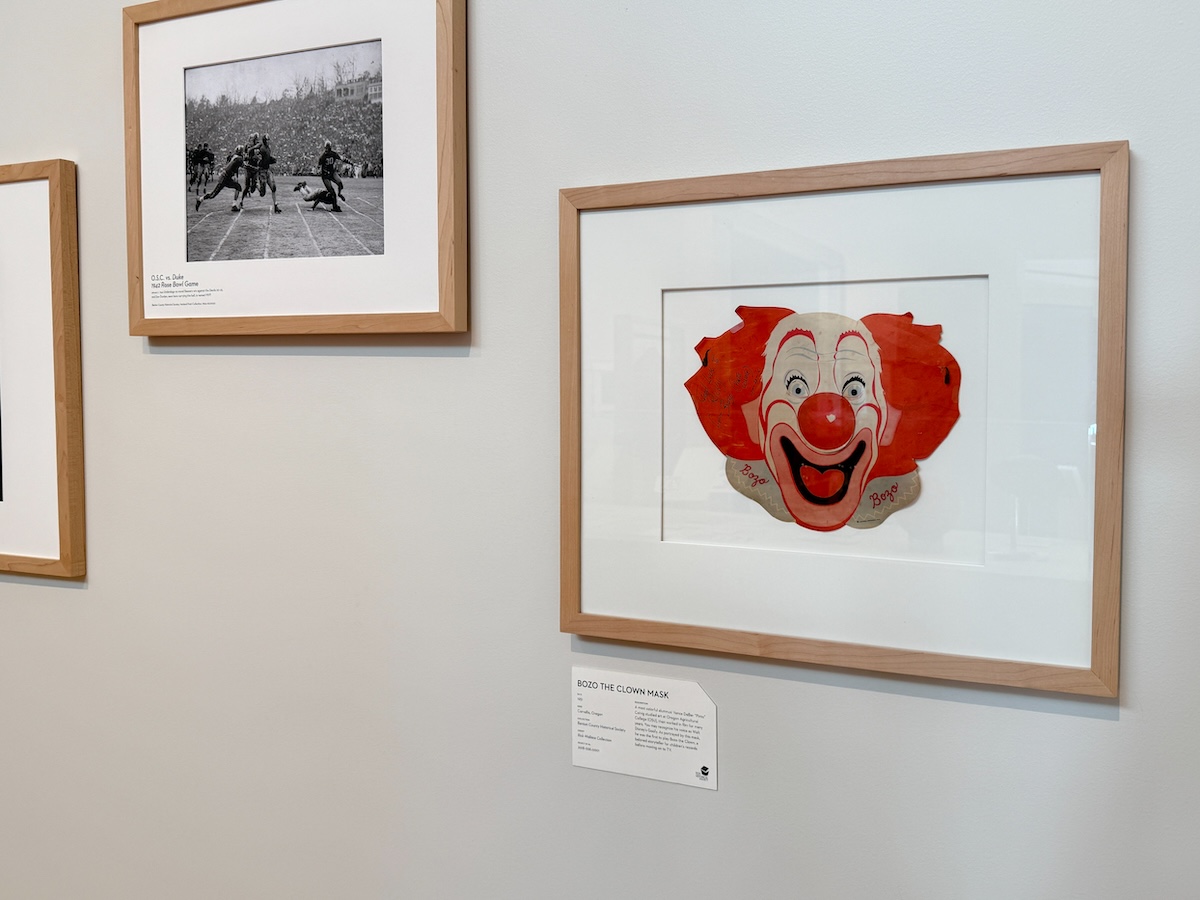
I learned that Vance DeBar “Pinto” Colvig, a student at Oregon Agricultural College before it became OSU, was the first Bozo the Clown. This strikes me as the sort of thing that should be included in every official history of Corvallis, whether it belongs there or not.
Most of us know our hometowns within the narrow slice of time when we happened to live there—our schools, our neighborhoods, our hangouts, and whatever happened to be important while we were growing up. Everything that came before feels distant and unimportant. And everything that happened after feels like somebody else’s story.
But the Corvallis I remembered from 1982 wasn’t the Corvallis that exists today. Looking at that old postcard, I realized it wasn't even the Corvallis I lived in. The town had been changing long before I arrived and continued changing long after I left.
Irritatingly, no one asked for my permission.
The museum also reminded me that Corvallis is more than it appears to be. For years, I’ve delighted my friends by endlessly repeating the fact that maraschino cherries were invented in Corvallis. Not the fancy Luxardo ones. The bright red supermarket ones that decorate sundaes, Jell-O salads, and the occasional (regrettable) fruitcake. No kidding. They were developed right here in Corvallis by OSU researchers looking for better ways to preserve local crops. And if that isn’t the most Corvallis story ever, I don’t know what is. Faced with a problem, the town’s response was to apply agricultural science so the world had more chemically immortal cherries.
And then there’s Montana. It turns out there is another Corvallis, if you can believe it. In 1879, settlers from my Corvallis ventured out and founded a town in western Montana, naming it after the one they'd left behind. This is, of course, baffling to me. Eighteen-year-old Geoff's plans for Corvallis mostly involved leaving it. These people moved more than 500 miles away and immediately decided that what their new state needed was another Corvallis.
Good for them. I guess?
The longer I wandered through the museum, the more I realized that every town probably has stories like these. Most of us just don’t notice them because they’re part of the background noise. The local trivia, odd traditions, and bits of community history just become invisible. From the inside, every place feels ordinary. From the outside—or 40 years later—it rarely does.
I still don’t want to live here, but I’ve stopped arguing with the fact that it matters.








Write a comment