

I ended up visiting the Sagrada Família three times while we were in Barcelona. Which turned out to be a good thing. Each visit revealed something the last one didn’t, and frankly, it’s the kind of place that’s way too much to process in one fell swoop, anyway.
For my first visit, Rick stood in for Krista on a guided tour she’d booked—right before she broke her foot.1 Guided tours typically mean you have to show up at a specific time, which is usually not a problem. If you remember which church you’re supposed to be meeting at. I did not. Turns out Barcelona has several important churches, and I’d assumed we were meeting at the cathedral—which is not the Sagrada Família. Common mistake. One’s the archbishop’s seat, and the other’s a mass of scaffolding with delusions of grandeur.
Also, as cruel fate would have it, the entire Iberian Peninsula went dark that day.2 Trains and buses stalled. Phones and navigation apps blinked out. People spilled into the streets, looking confused and lost. So we walked—fast and far. Spoiler: We did make it. But only barely.
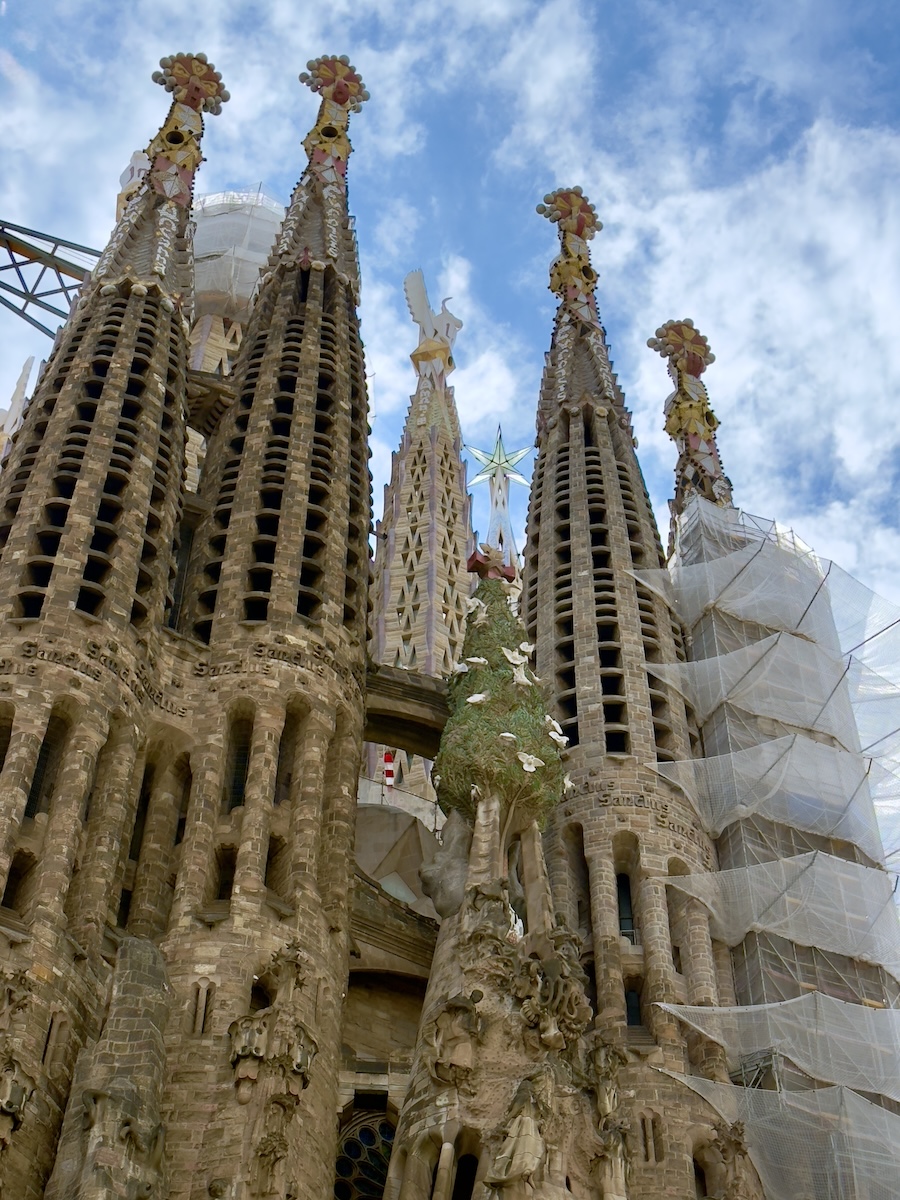
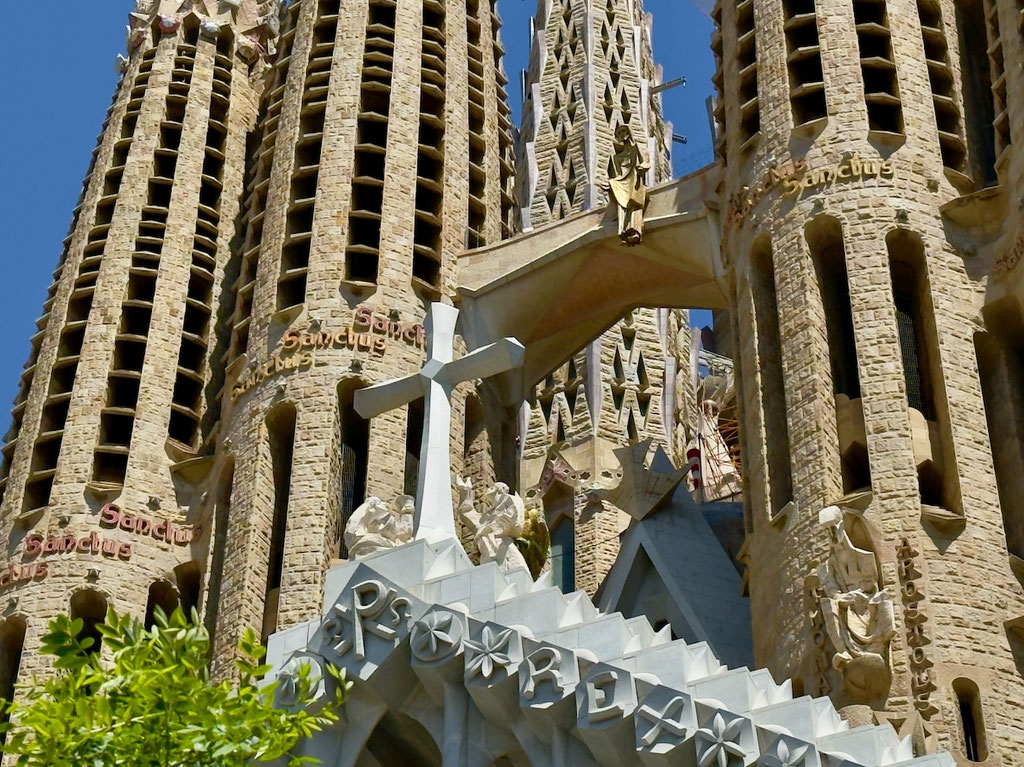
As we caught our breath and let our core temperature fall slightly, we got our first good look at the Sagrada— equal parts devotion and delirium. It's magnificent, yes, but also too much, like someone built a cathedral after losing a bet. The cranes and scaffolding have been there so long that they may already be listed in the heritage register.3
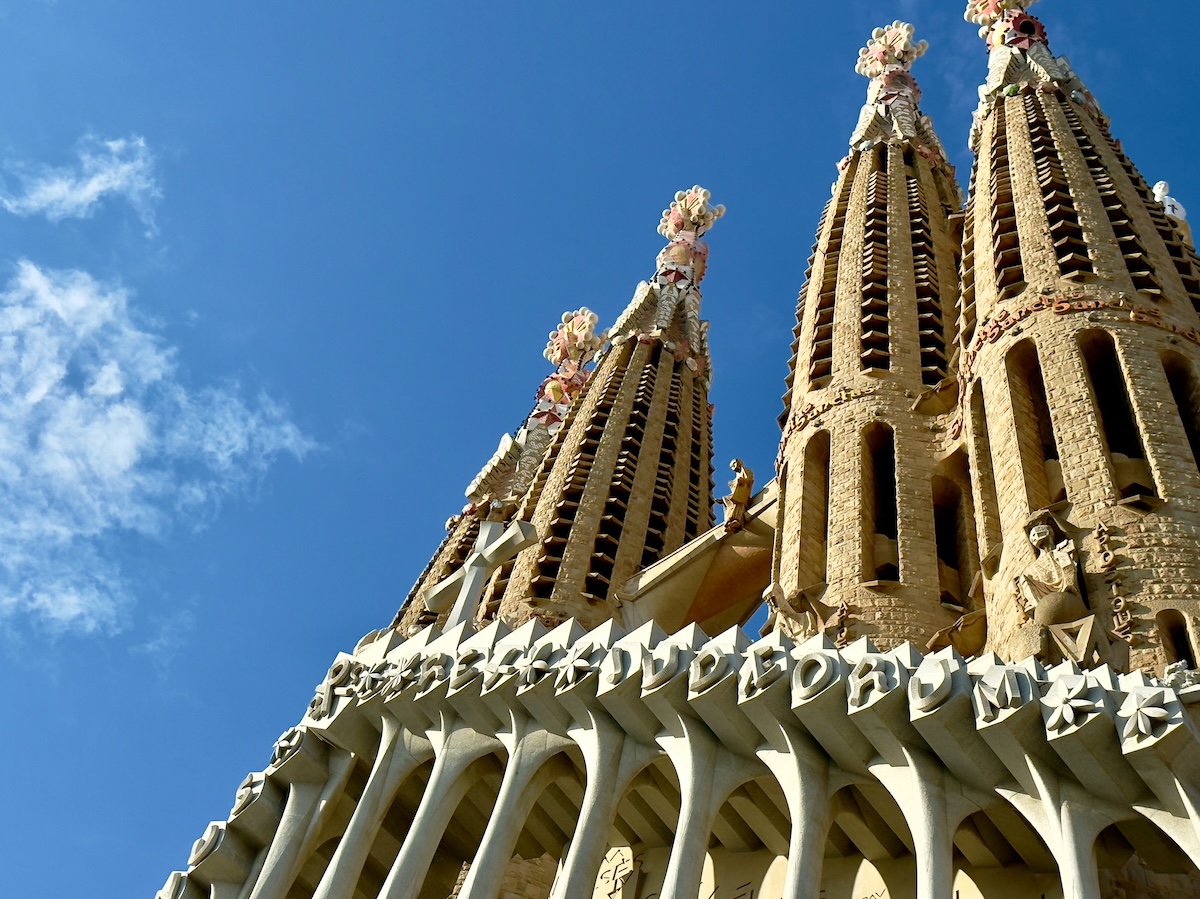
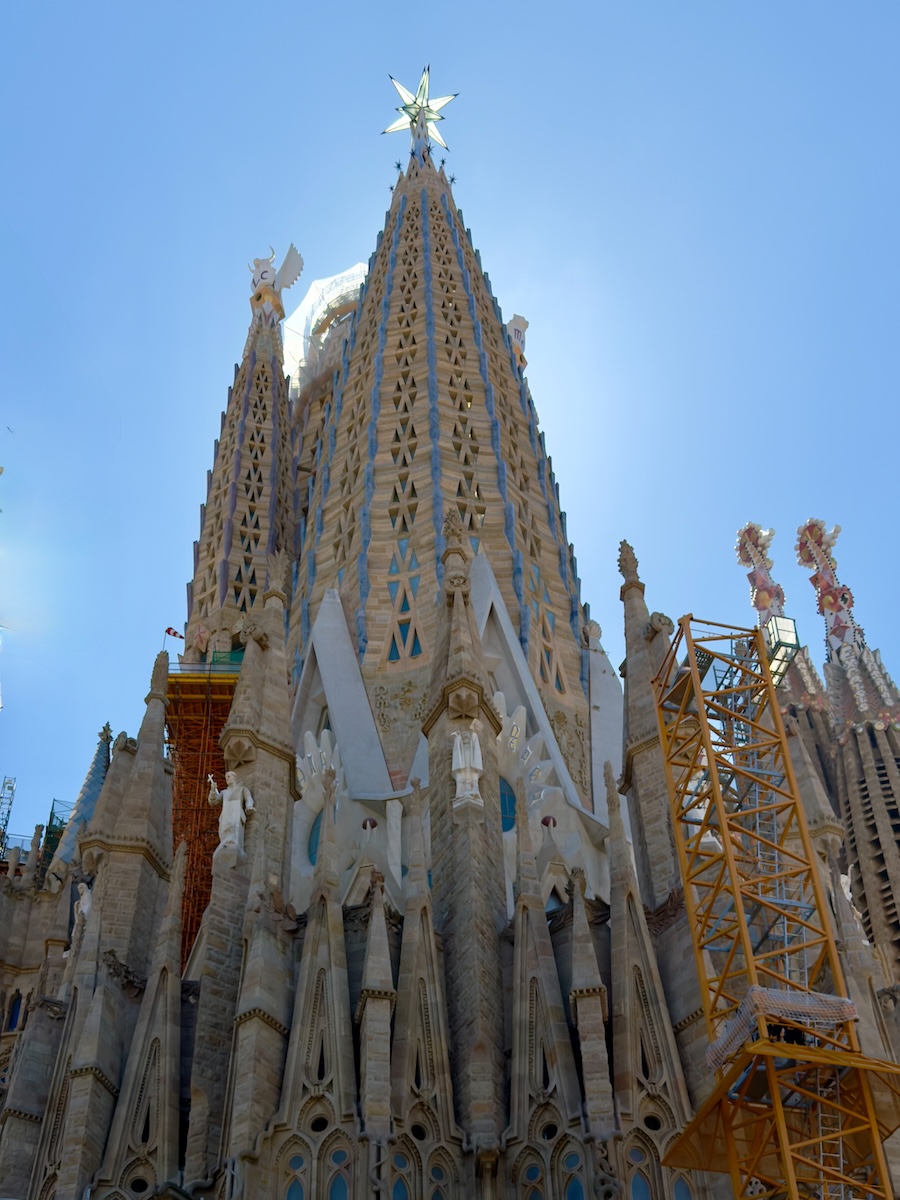
Eventually, there will be 18 towers—12 for the apostles, four for the evangelists, one for the Virgin Mary, and one—the tallest, at 564 feet—for Jesus T. Christ Himself.4 When complete, it will be the tallest church in the world, overtaking Ulm Minster in Germany.5
The Sagrada will ultimately have three main façades. The Nativity, on the east side, was designed and begun by Gaudí himself. It’s dense, ornate, and overwhelming, with scenes from the birth of Christ, animals, plants, angels, and saints, all stacked together like the world's most determined wedding cake. The Passion façade, on the west, came much later and was built by other architects in a style that’s stark, angular, and deliberately harsh—telling the story of Christ’s suffering without sentimentality. The Glory façade, still unfinished on the south side, is meant to be the largest and most impressive of the three, symbolizing the road to God. Unfortunately, the road to God now runs straight through a row of ’70s apartment blocks, whose owners are determined to prevent said destruction.6
Our tour began on the Nativity side, the only façade Gaudí lived to see nearly completed. It faces east, toward the rising sun, which he thought appropriate for the story of birth.7 From here, even unfinished, the whole thing looks less like a building and more like a slow, losing argument with gravity.
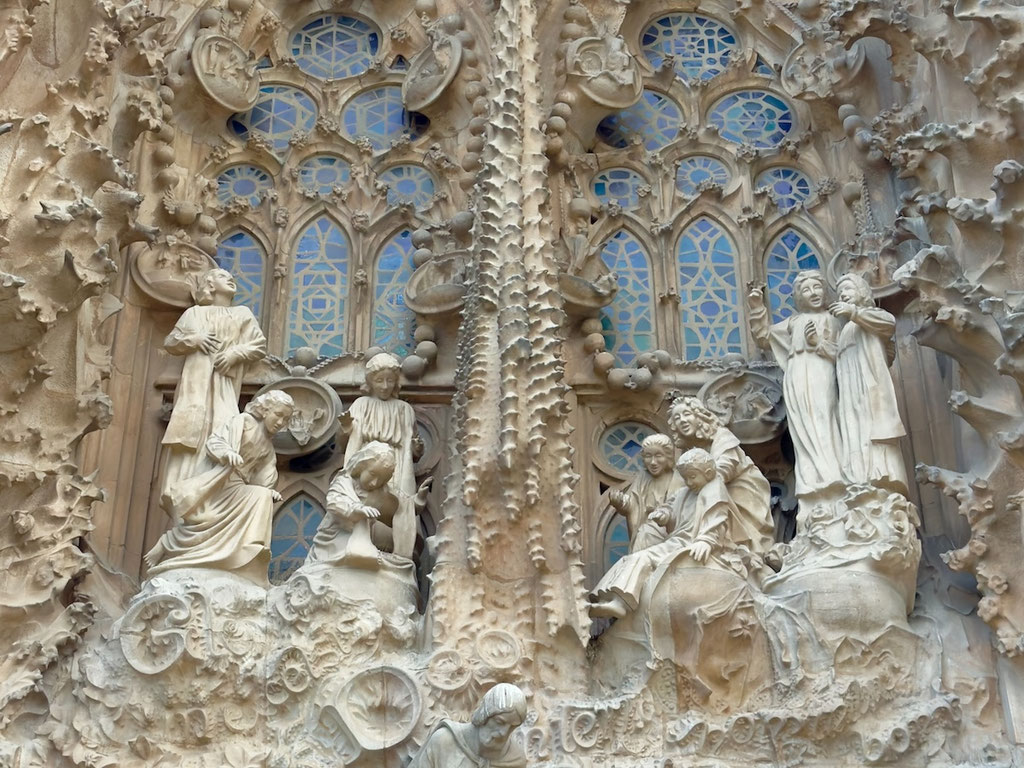
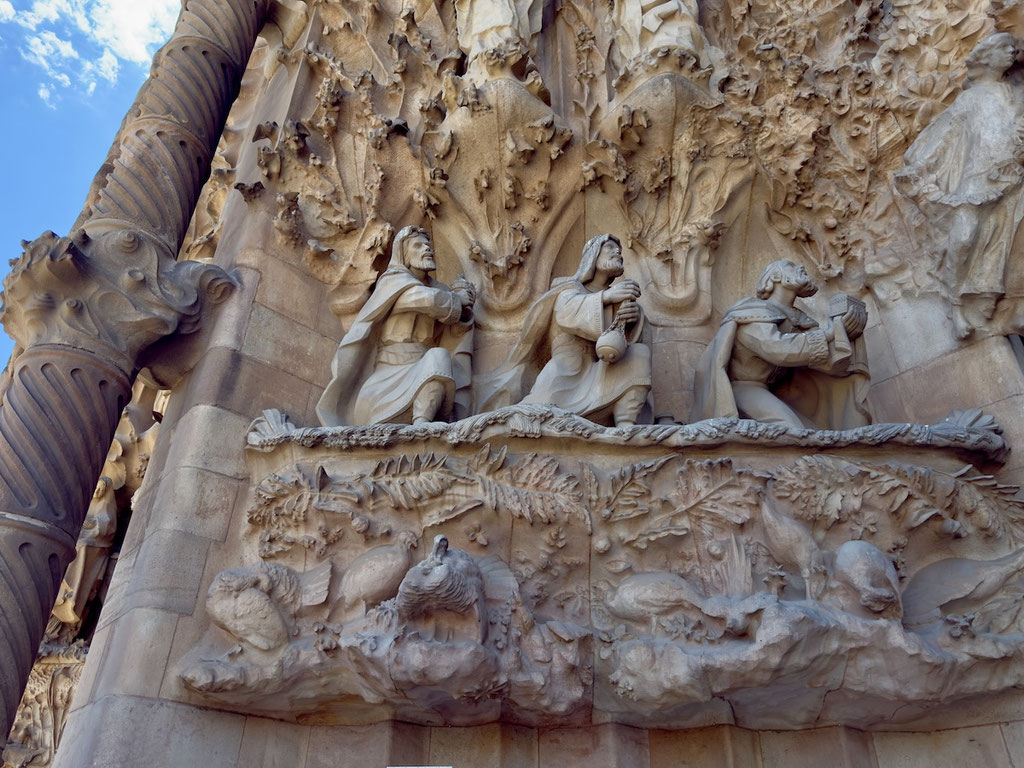
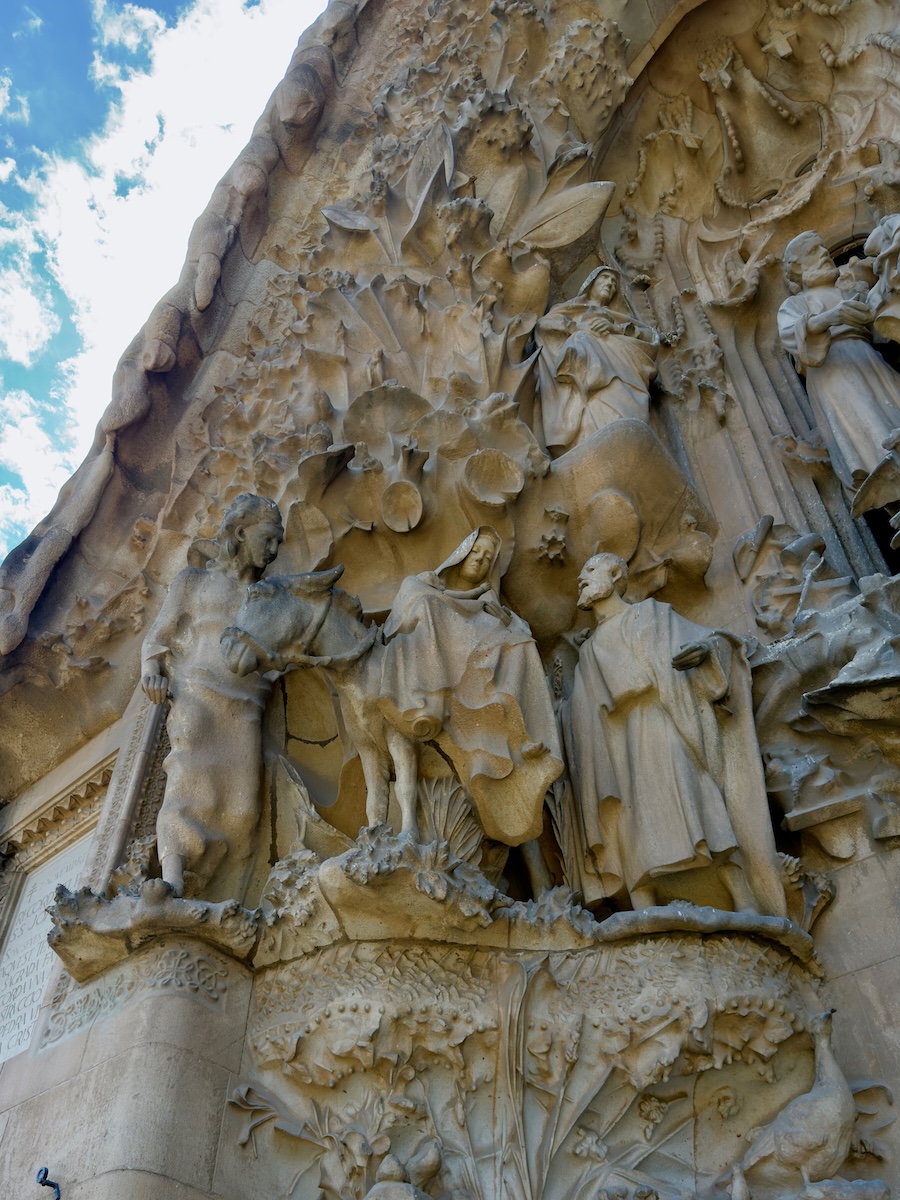
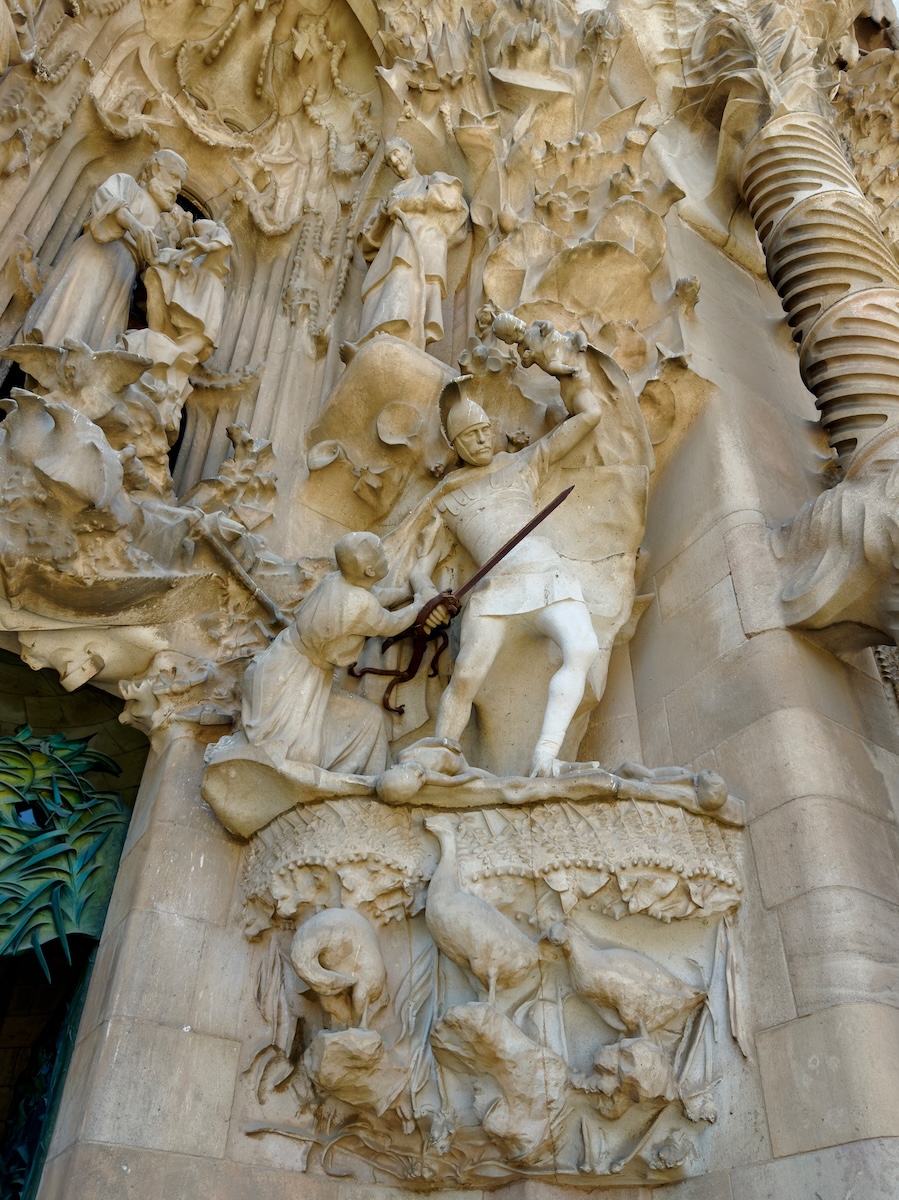
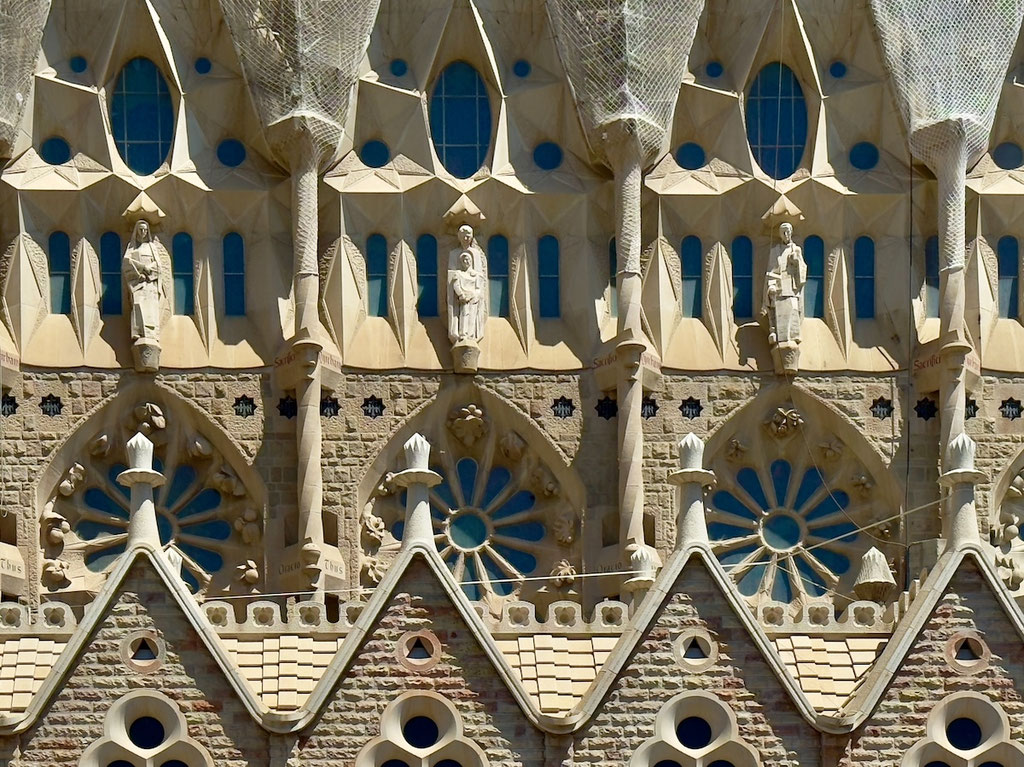
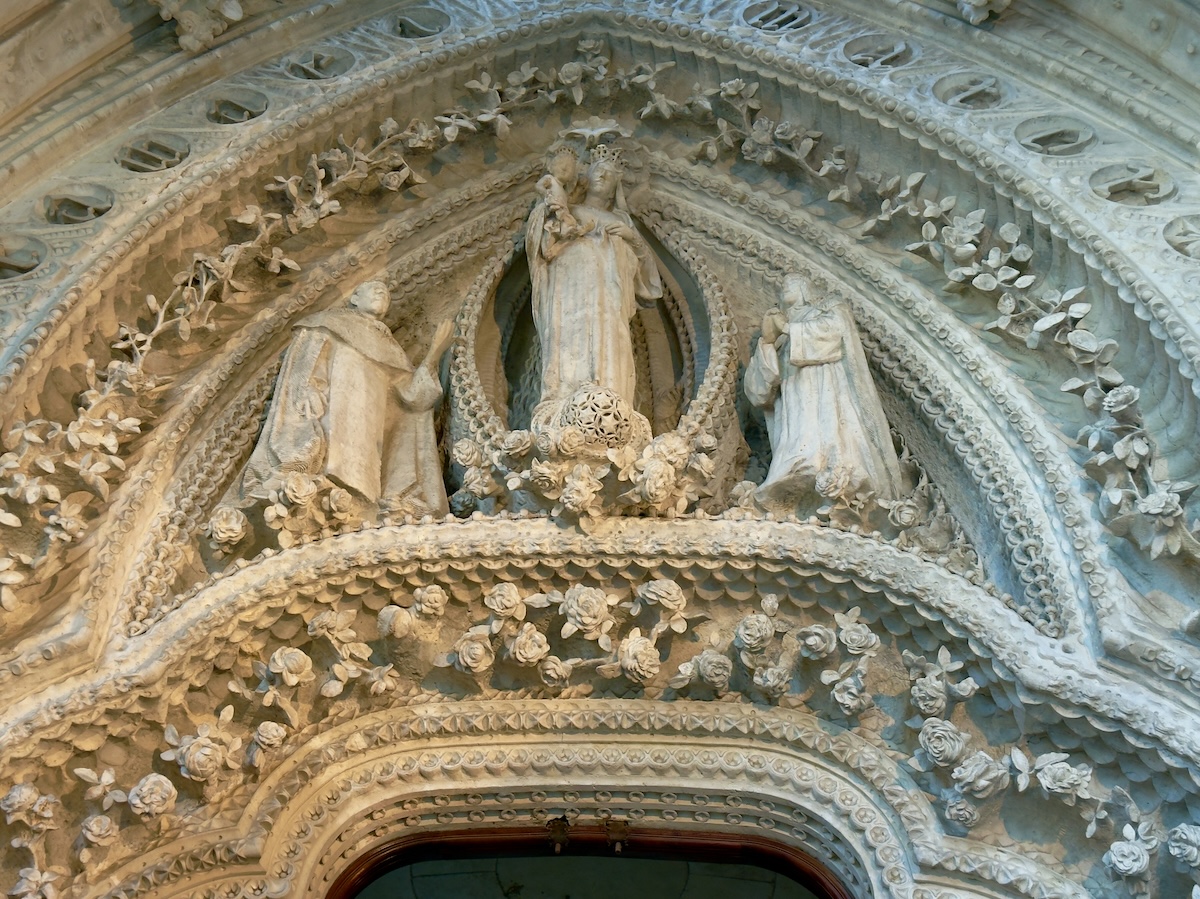
The façade itself is impossible to take in all at once. It's a stone narrative in three acts—the birth of Christ in the central portal, the Holy Family's flight into Egypt on one side, and scenes from Mary's life on the other. Every inch of it is alive with ivy, roses, doves, sheep, angels, fruit, shells—Gaudí's attempt to fold creation itself into scripture. Nothing here feels ornamental, it's as if the gospel started sprouting.

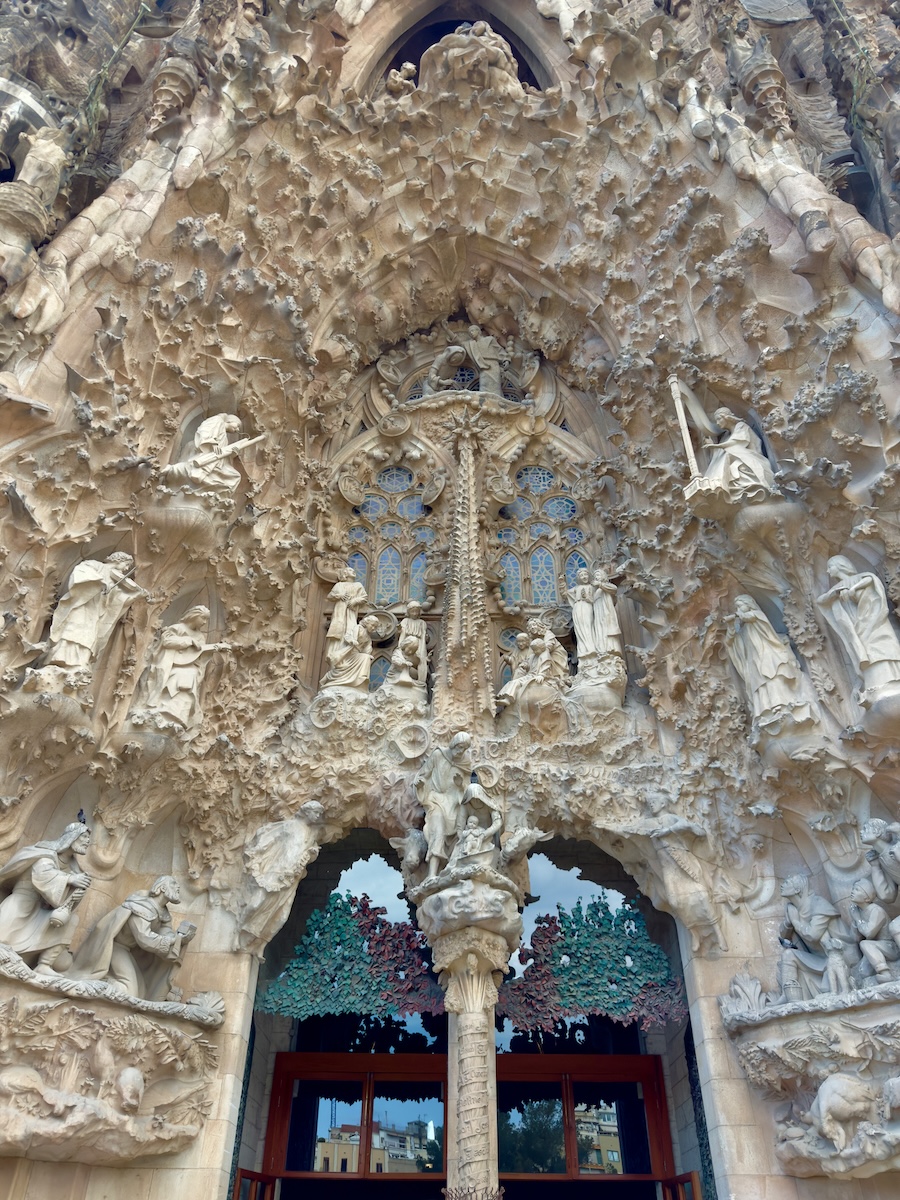
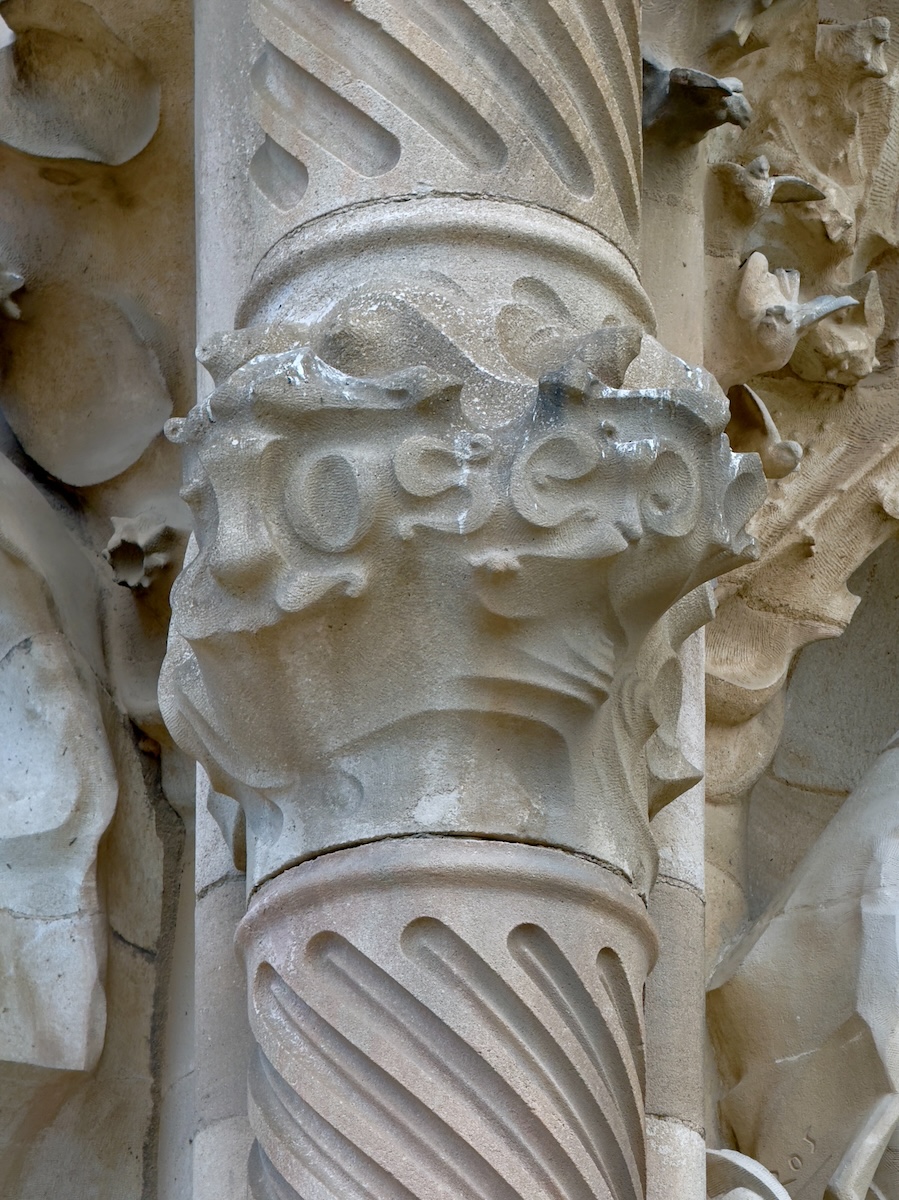
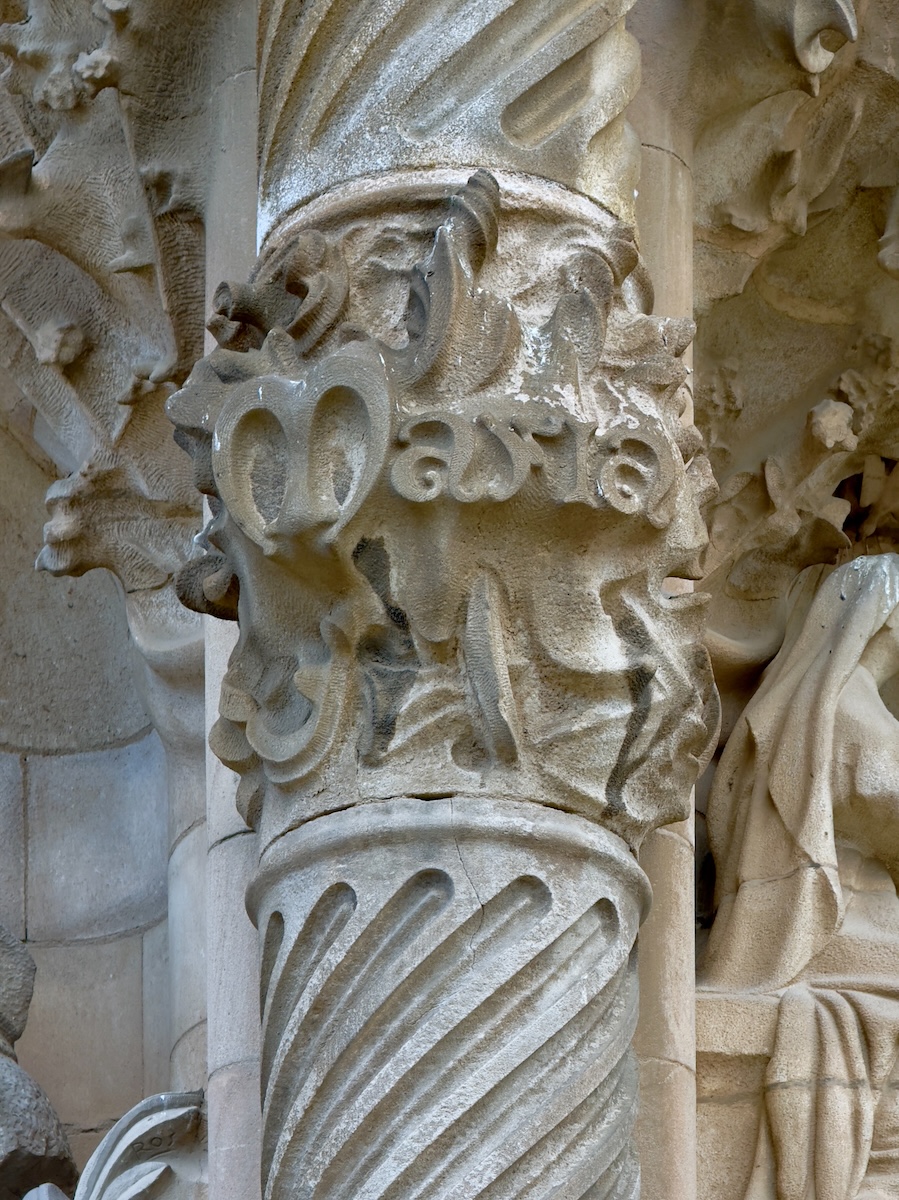
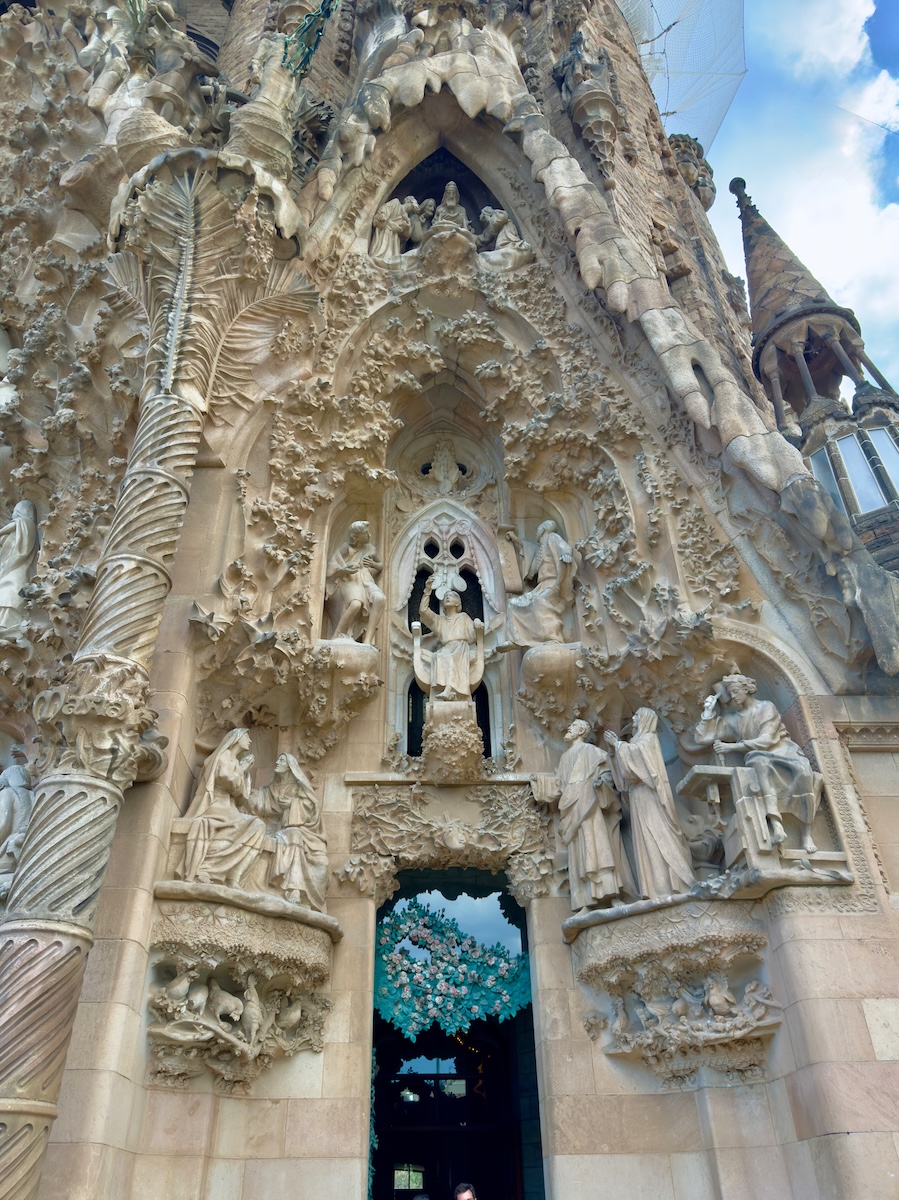
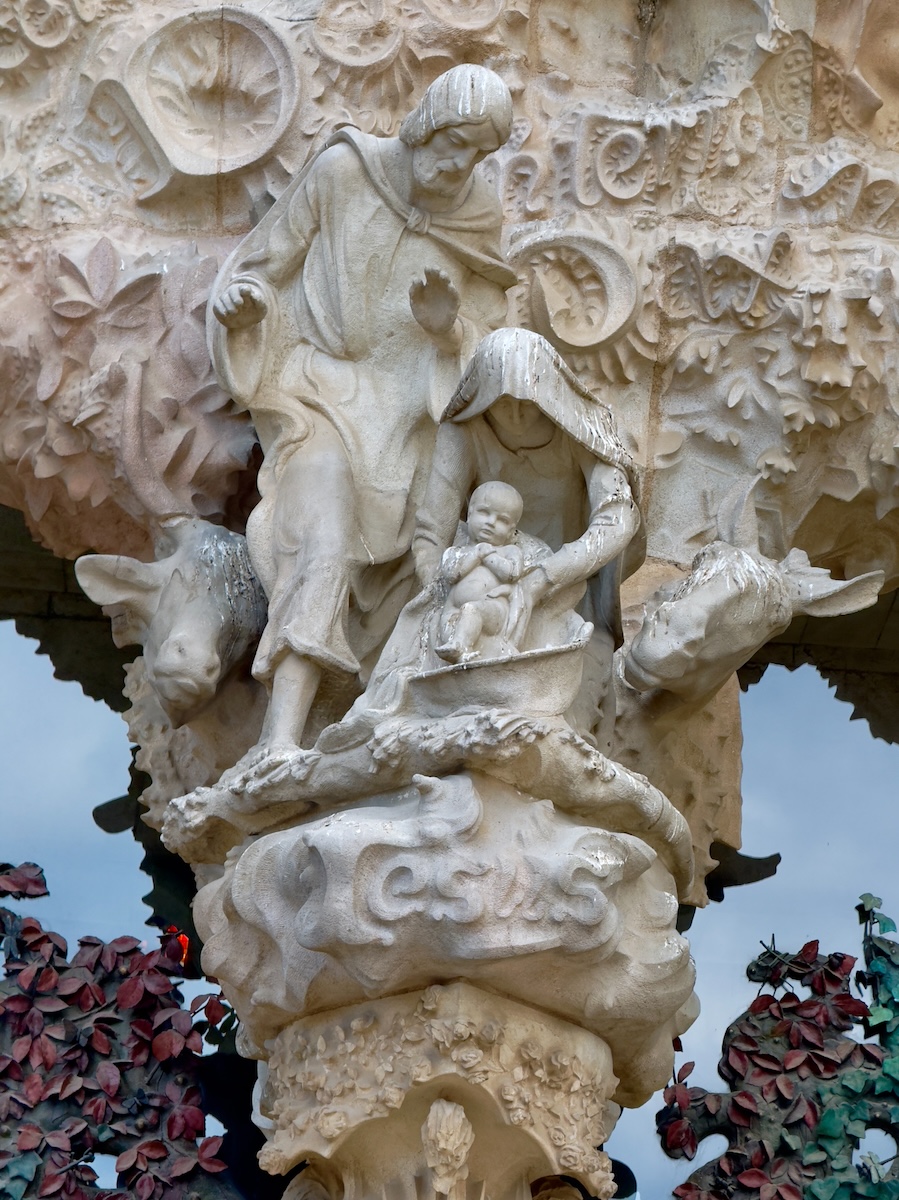
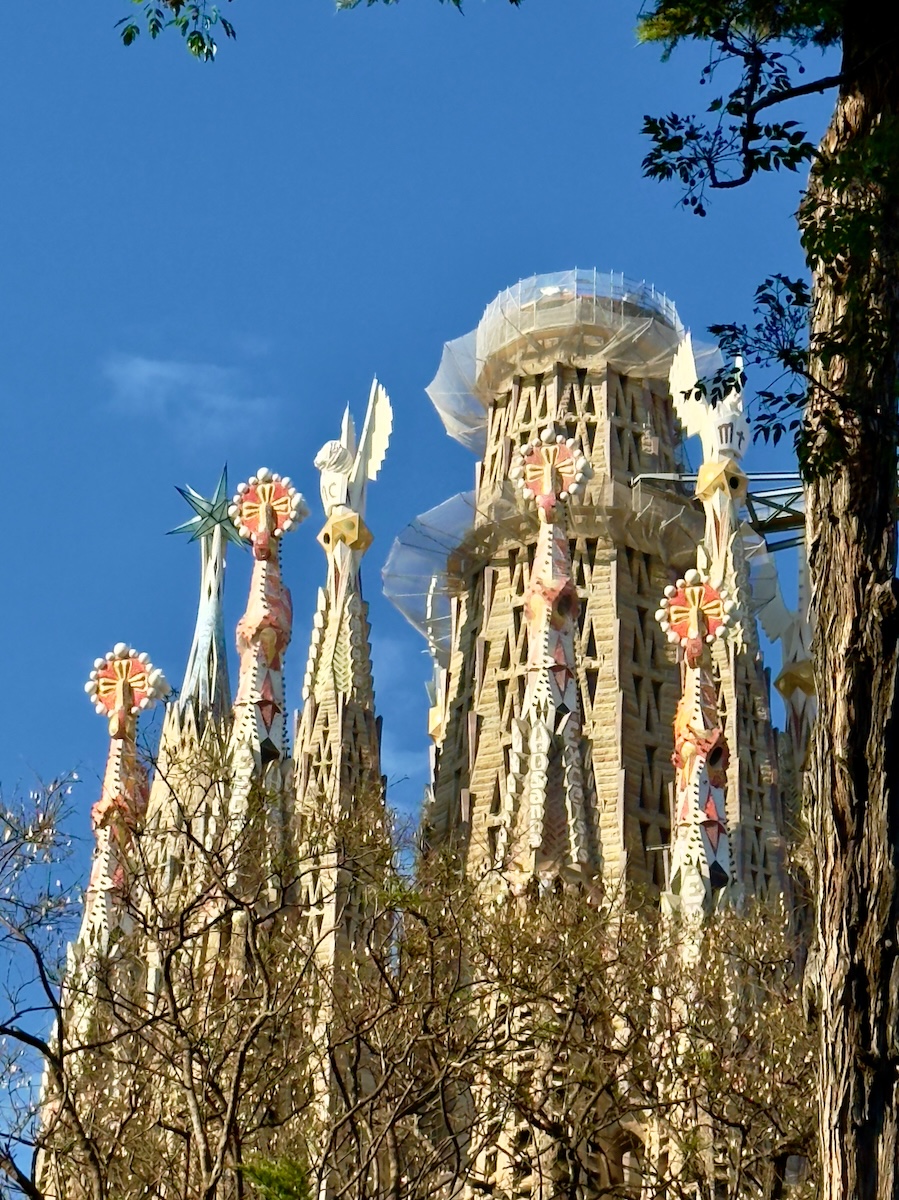
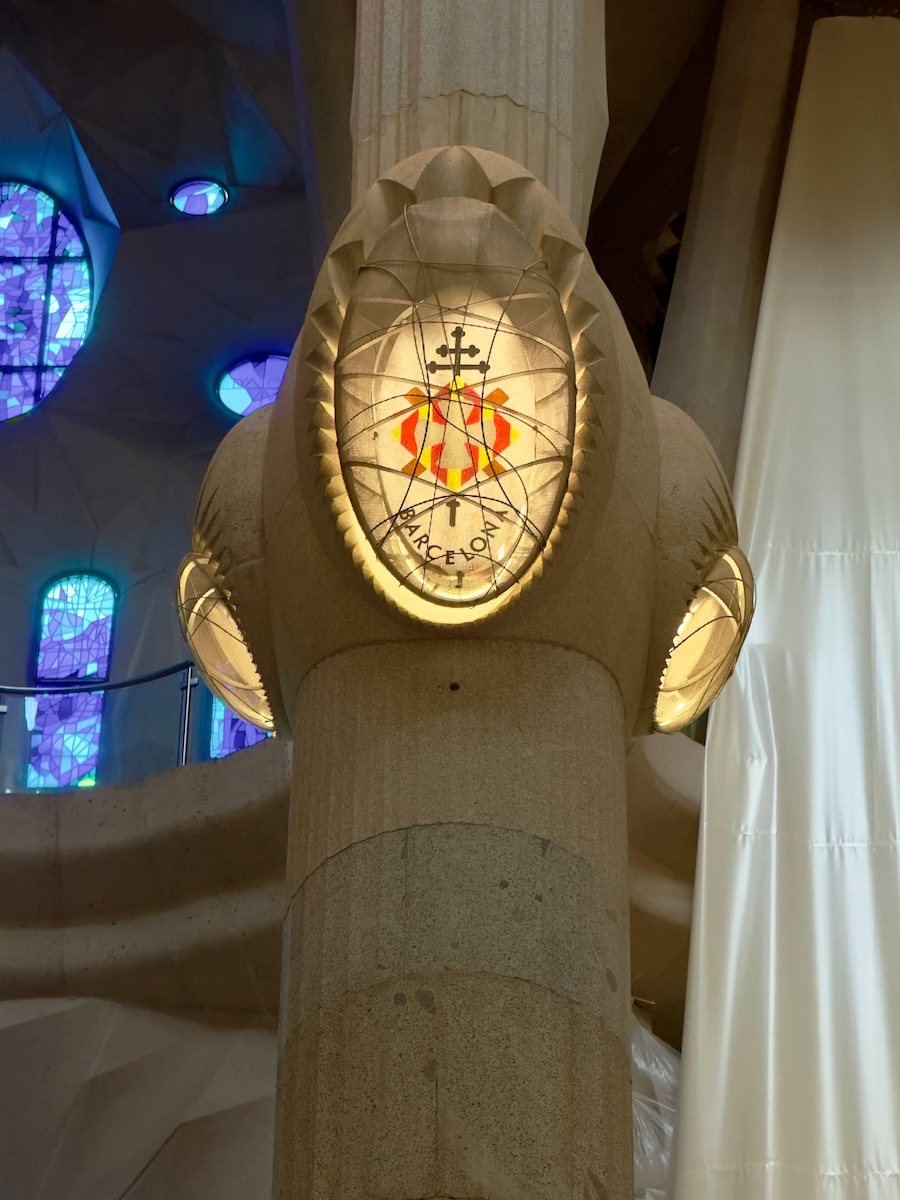
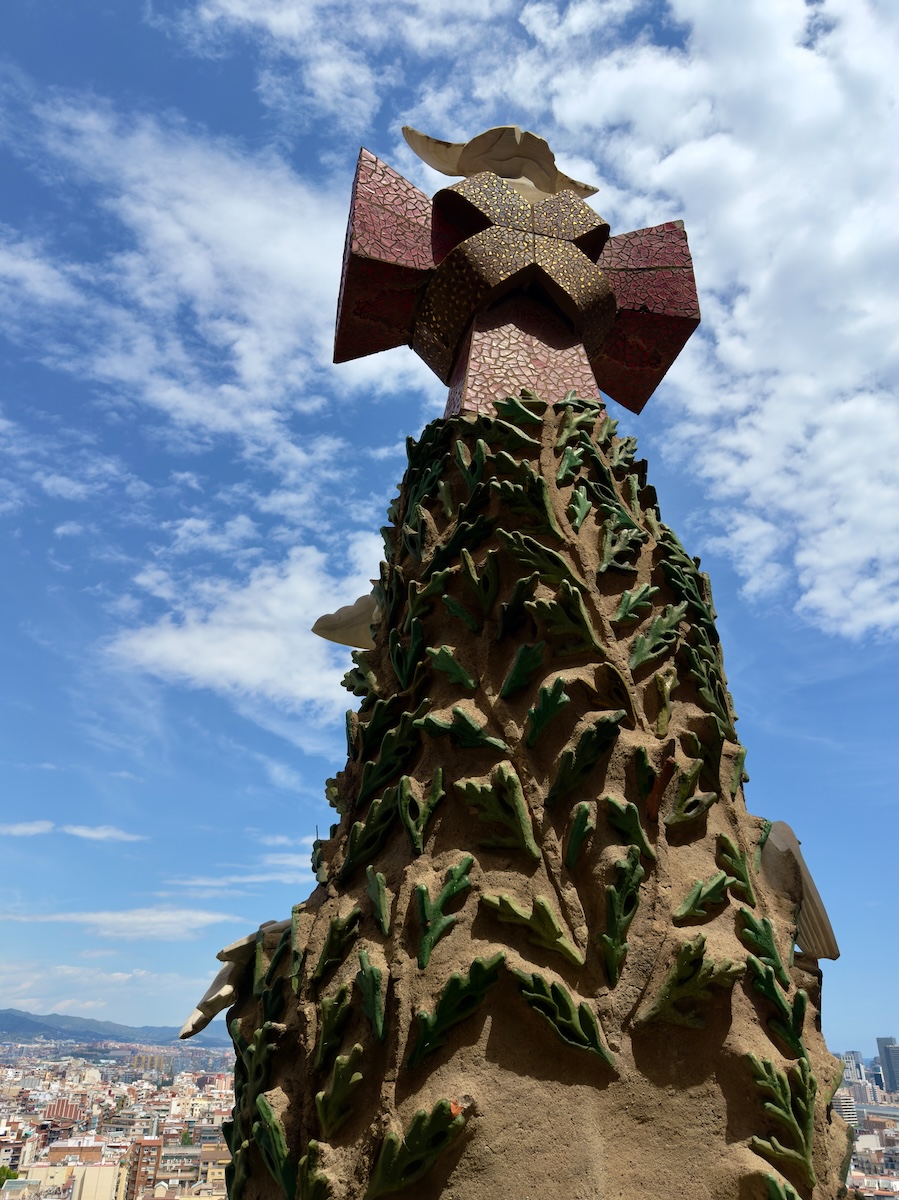
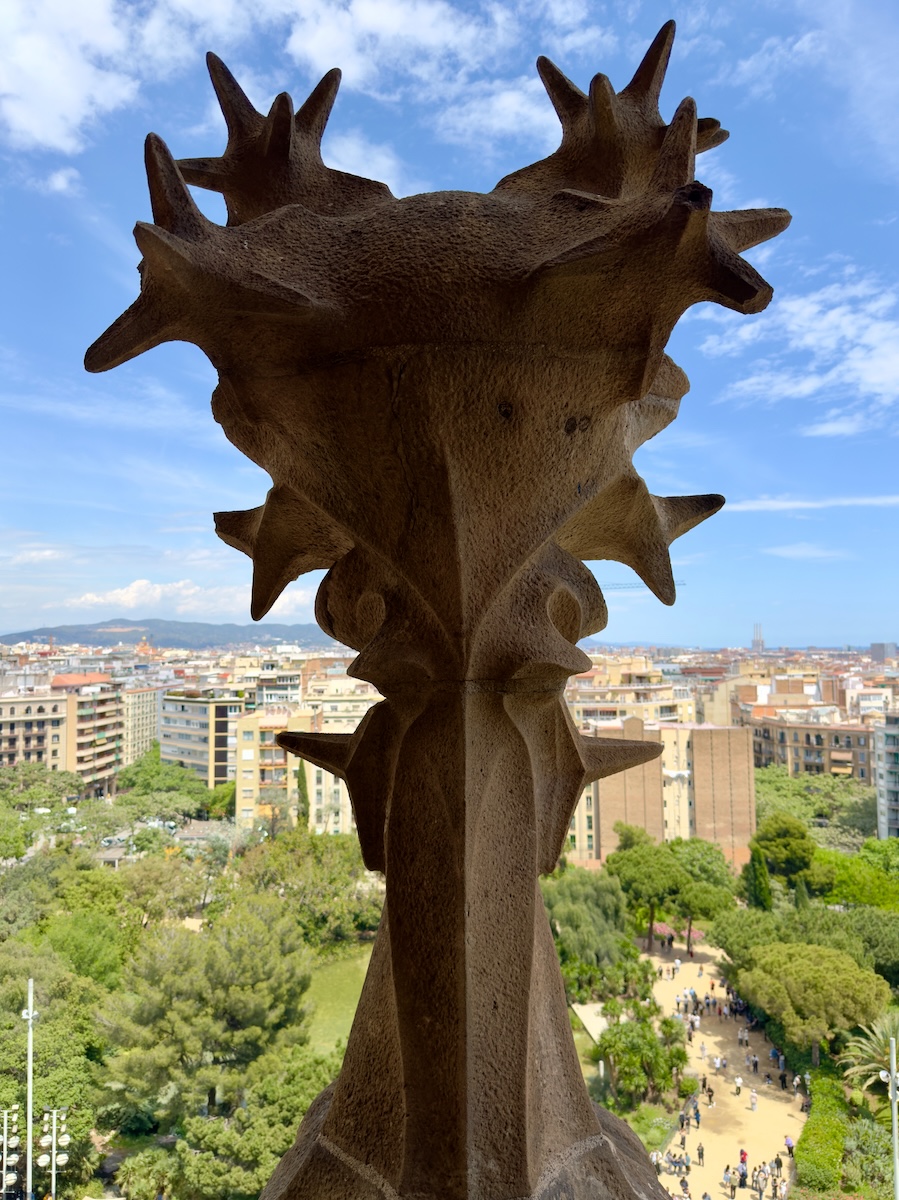
Gaudí was driven by three things—faith, nature, and Catalonia—and the façade manages to preach all three at once. Faith came first. Every design choice was an act of devotion, not ambition. Nature followed as teacher. His geometry was drawn from trees, shells, and honeycombs, the patterns of a world he considered God’s rough draft. Finally, Catalonia anchored it all, giving him the stone, symbols, and stubbornness to see it through. The stone is Montjuïc sandstone from the nearby mountain, while the jagged peaks of Montserrat—the spiritual heart of Catalonia—inspired the clustered spires that crown the basilica. Even the red-and-gold cross that tops the towers echoes the cross of the Senyera, the Catalan flag Gaudí considered as sacred as any relic. The cypress trees at the top are symbols of eternal life, a nod to both the landscape and the Catalan countryside he adored.
But his obsession with realism was its own gospel. He wanted every sculpted figure to feel alive, which meant they had to be alive first. Neighbors, friends, and laborers from the site were recruited to sit for plaster molds of their faces as they posed as angels, shepherds, or the Holy Family itself. Even the local donkey was roped in, though he reportedly refused to stand still long enough for the plaster to dry. Undeterred, Gaudí ordered the animal’s back hooves sunk into mud to keep him from wandering off—an early example of his (in)famous “attention to detail.”8 I’m sure the donkey was rewarded with a long, happy life afterward, free from toil. Probably with a pension.
Later, after Gaudí’s death, master craftsmen continued the tradition—some of them in China—casting their own faces and those of colleagues. Which explains why several figures in the Adoration scene have unmistakably Asian features. Even in absentia, Gaudí’s realism had gone global.
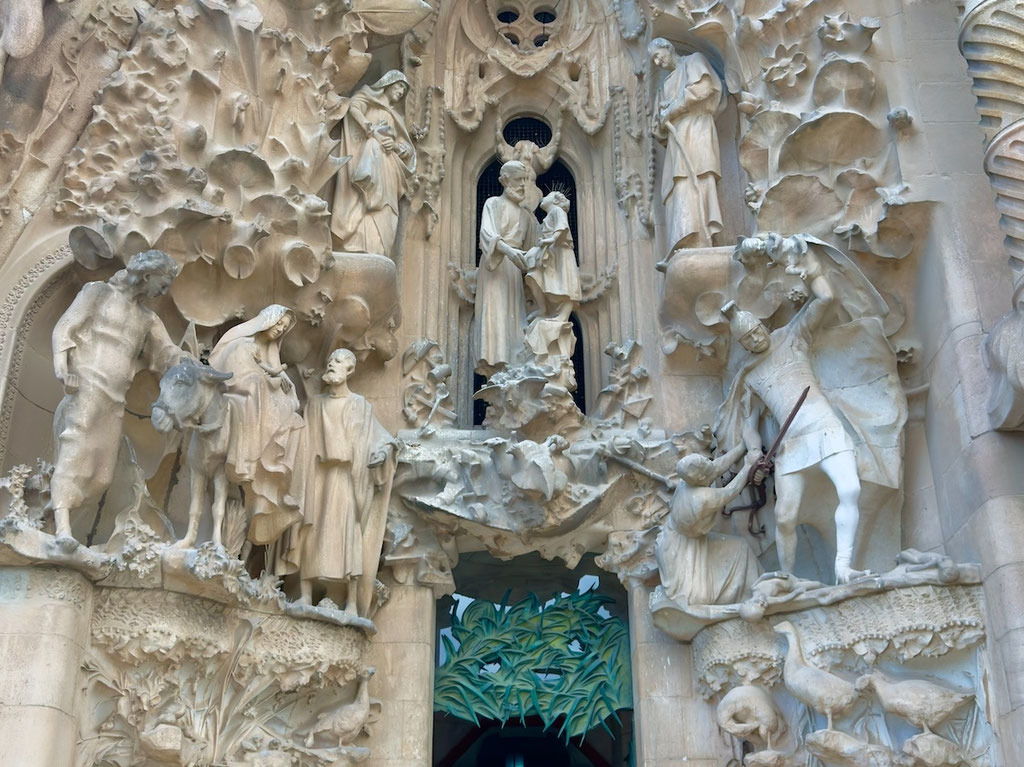

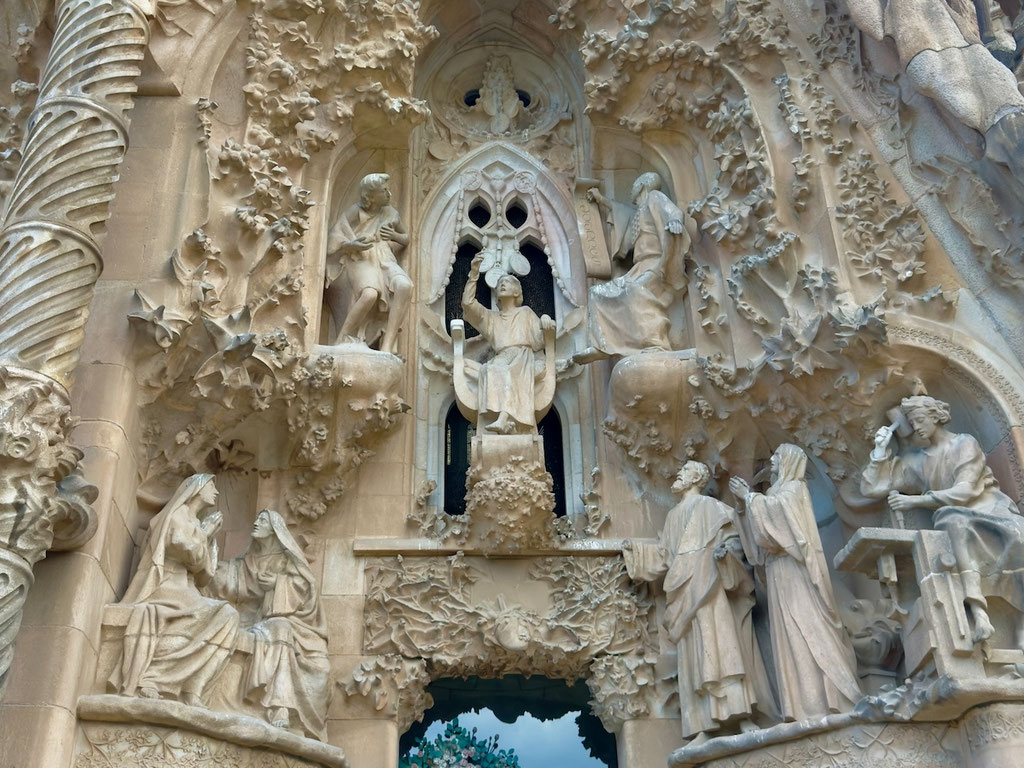
From the carved chaos of the façade, we moved through the ivied doors into something else entirely. The noisy traffic, stone, and sunlight faded, replaced by a kind of living quiet. It felt less like entering a church than stepping under a forest canopy.
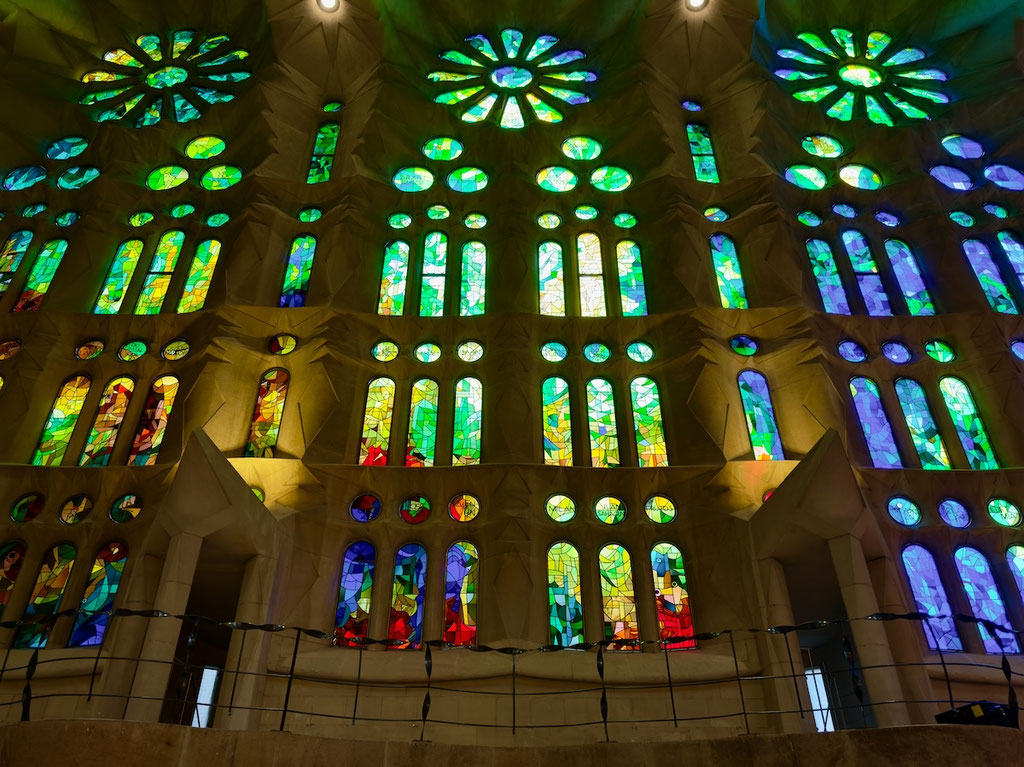
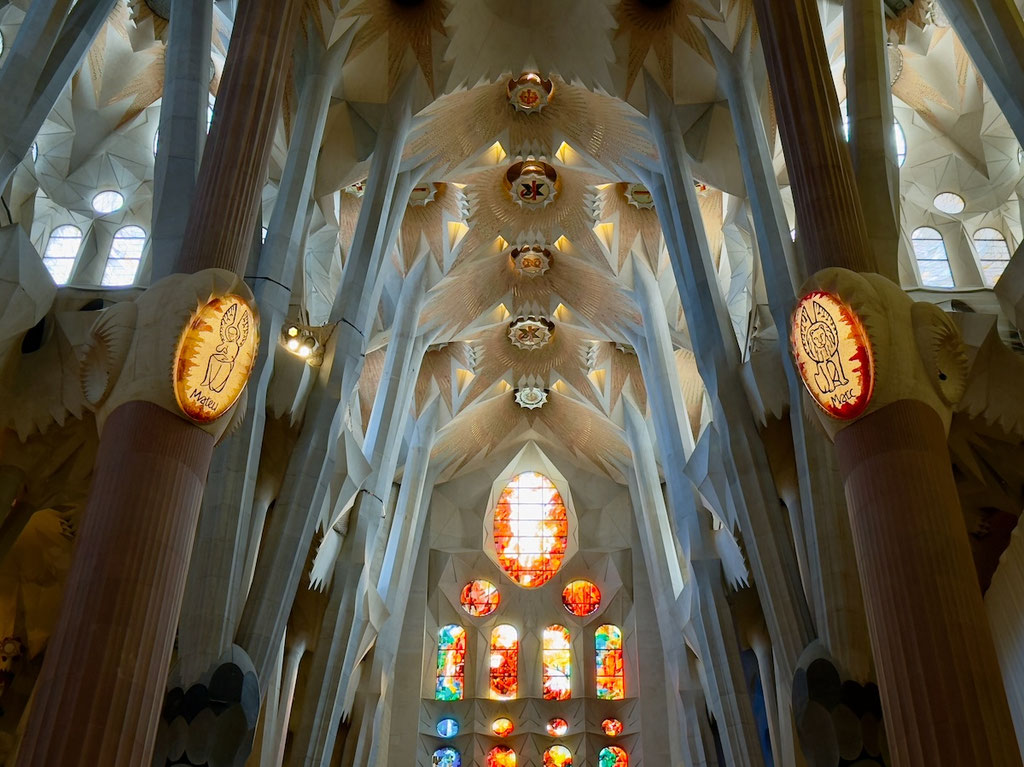
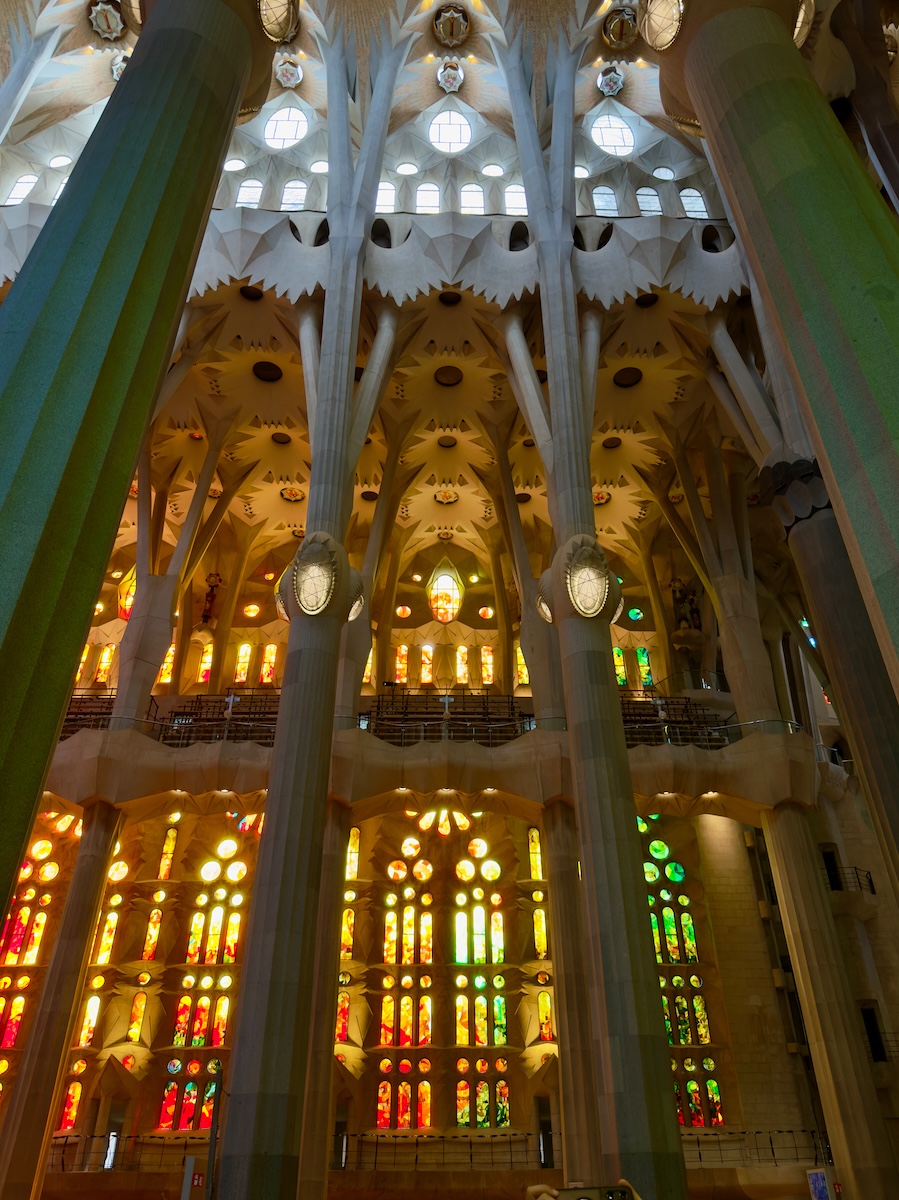
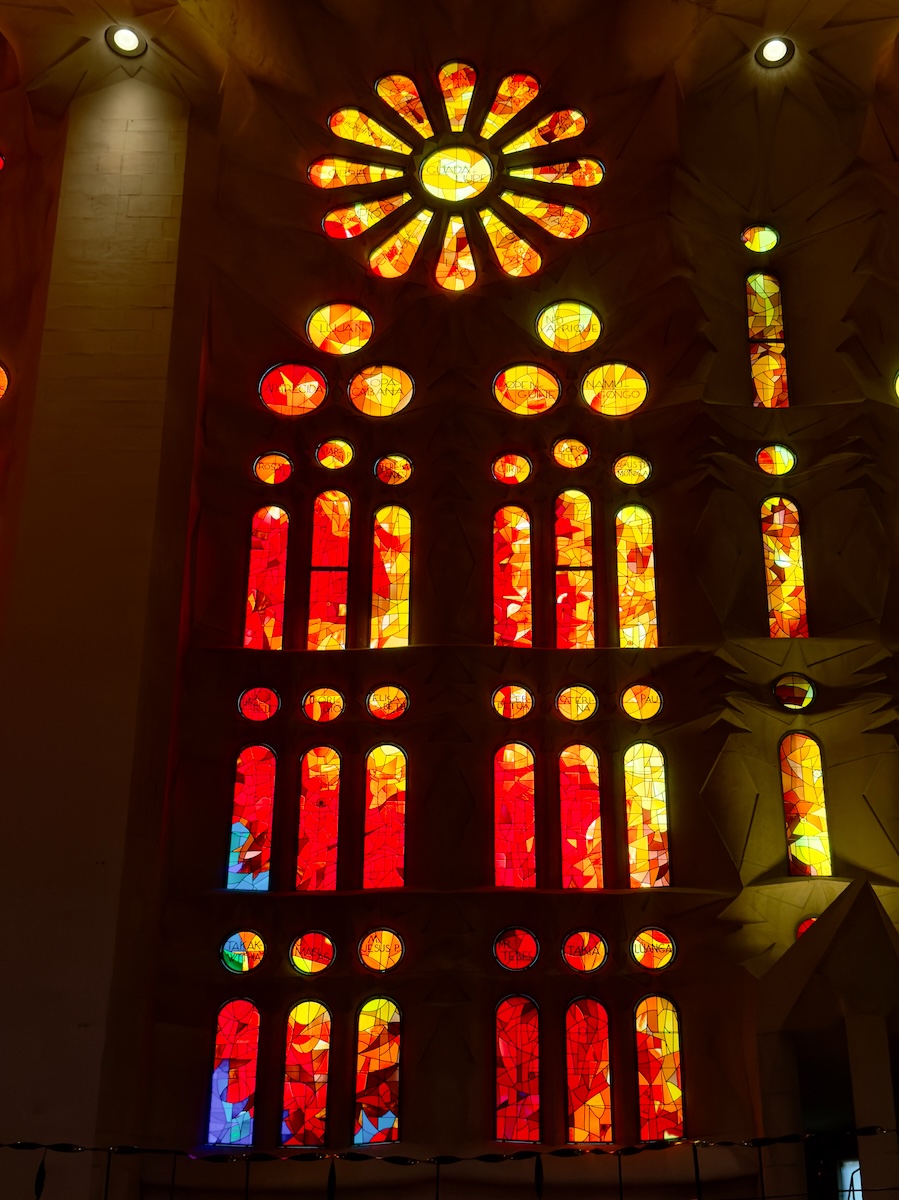
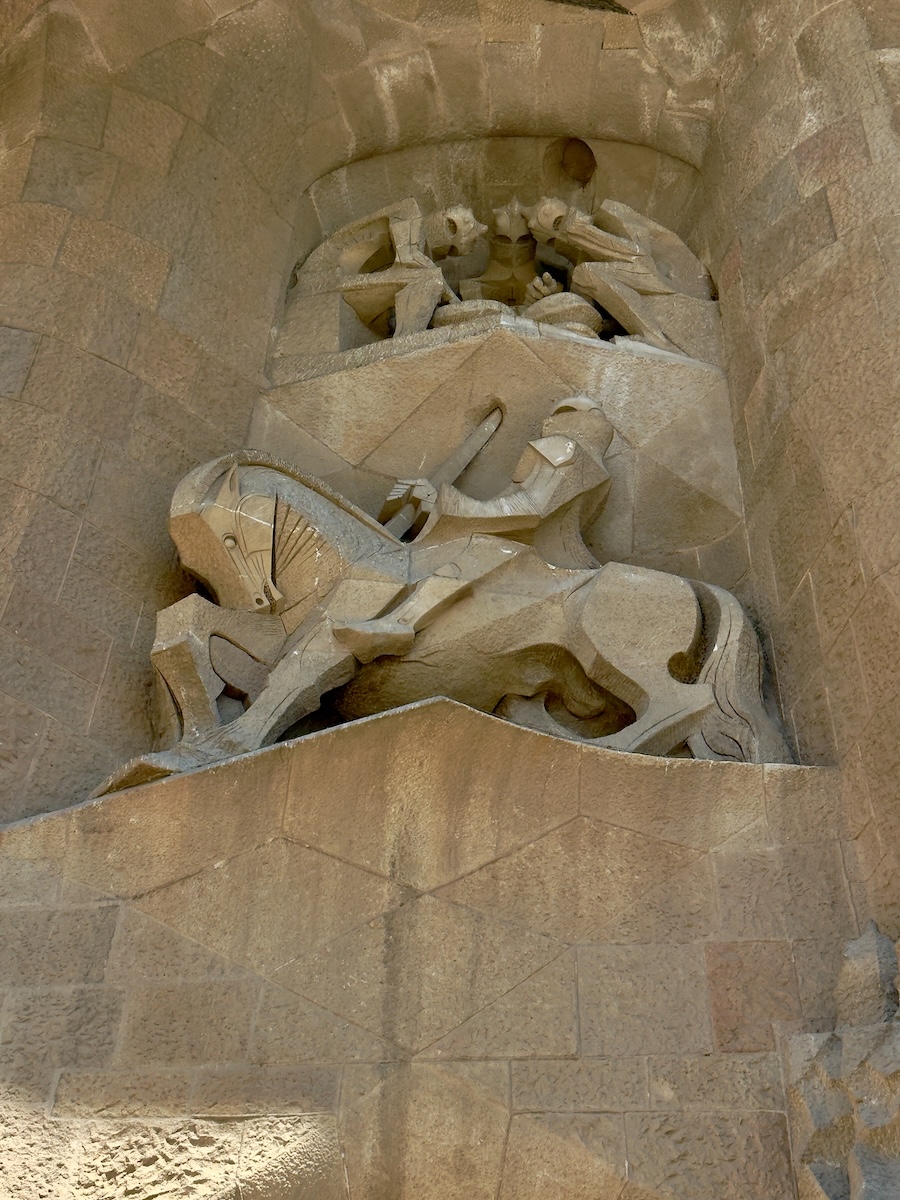
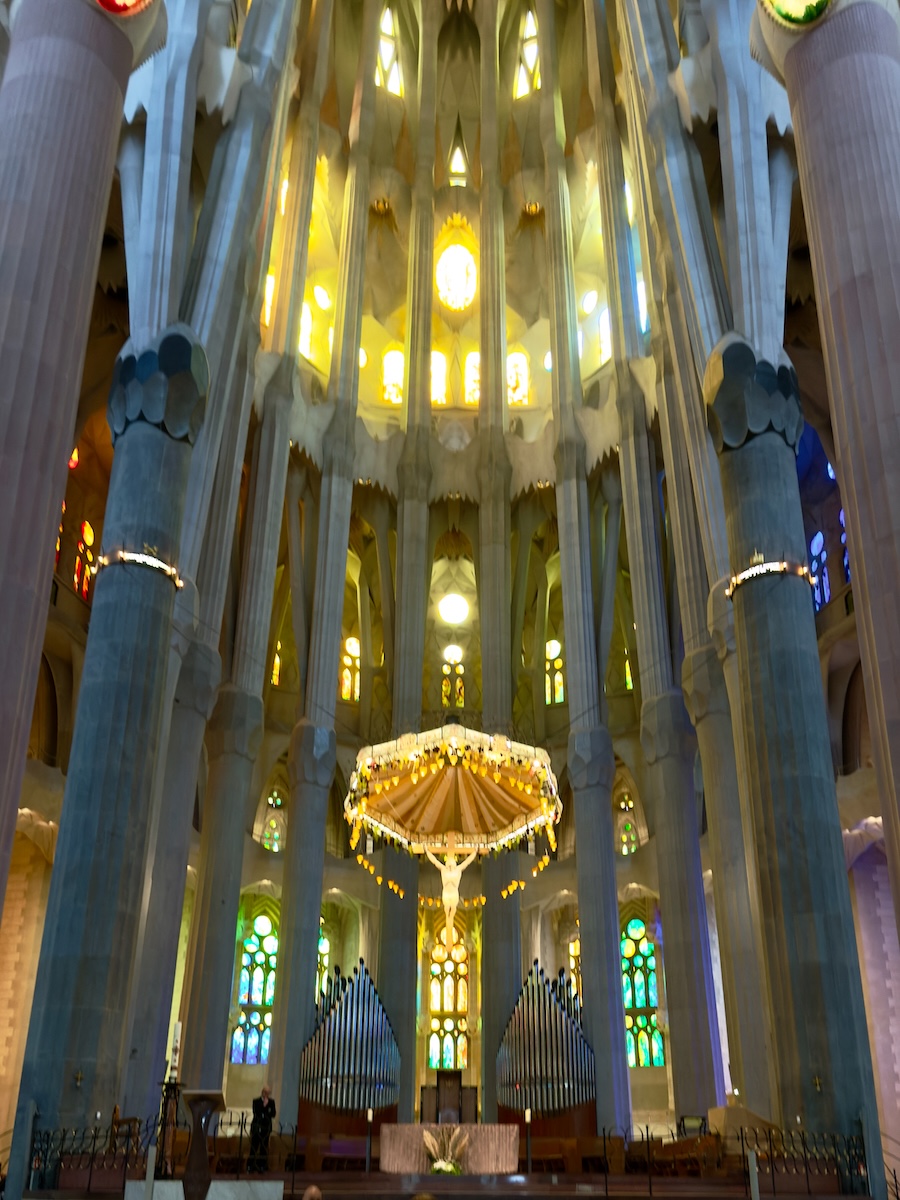
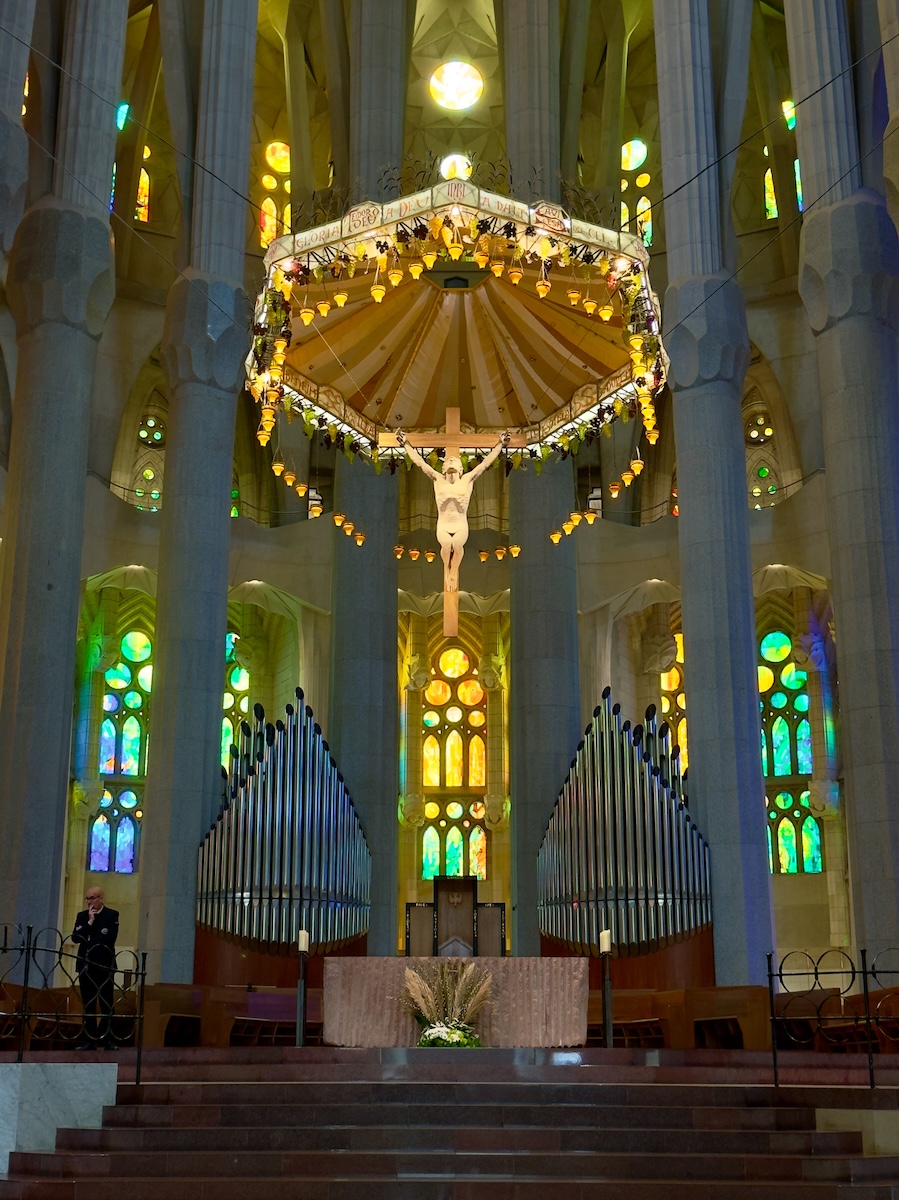
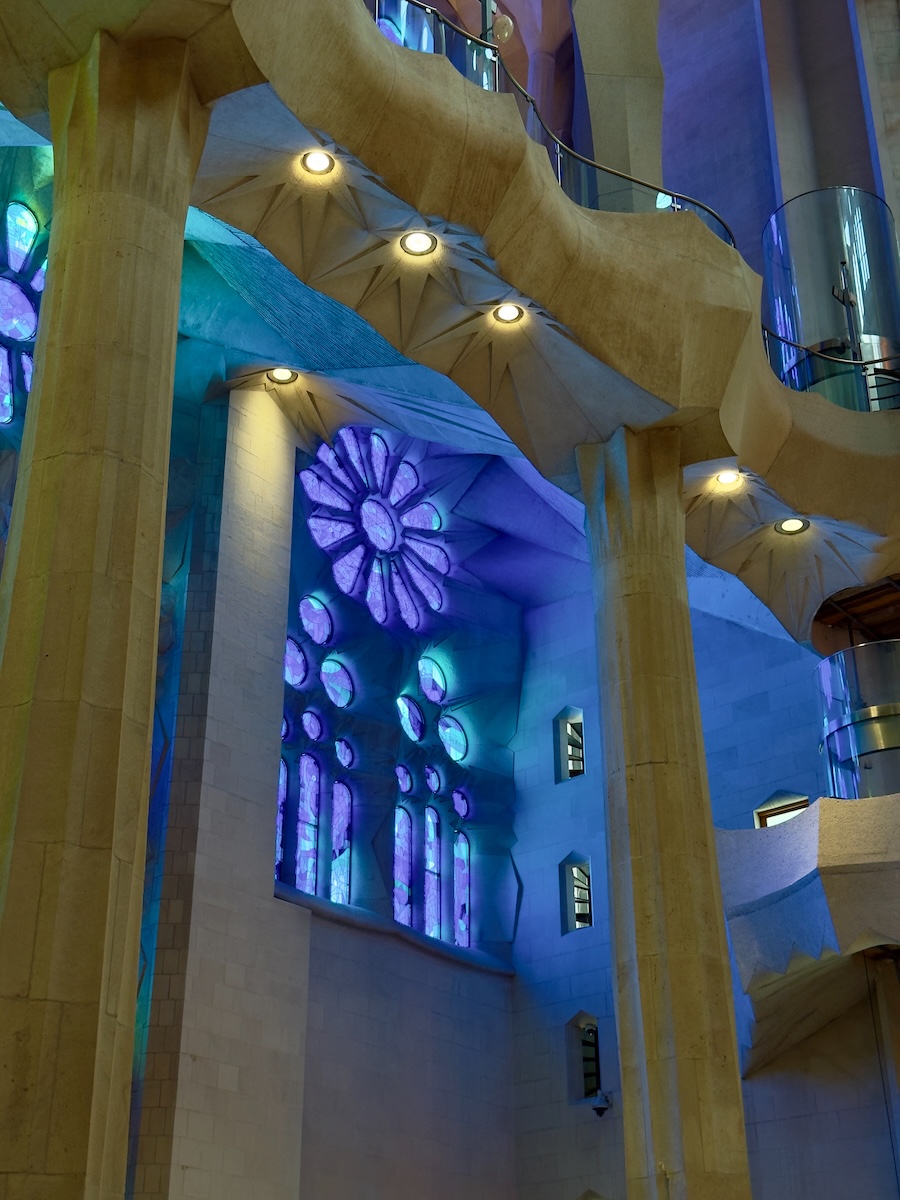
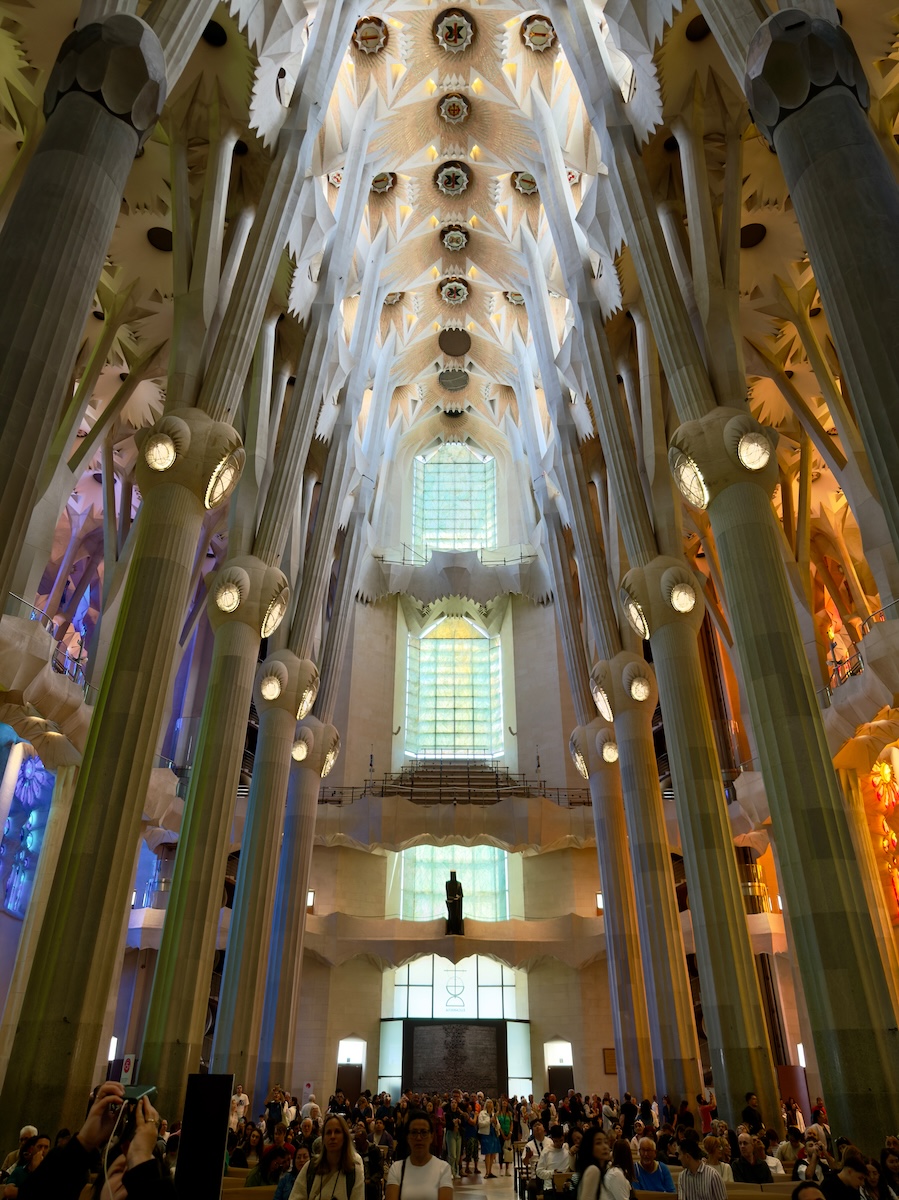
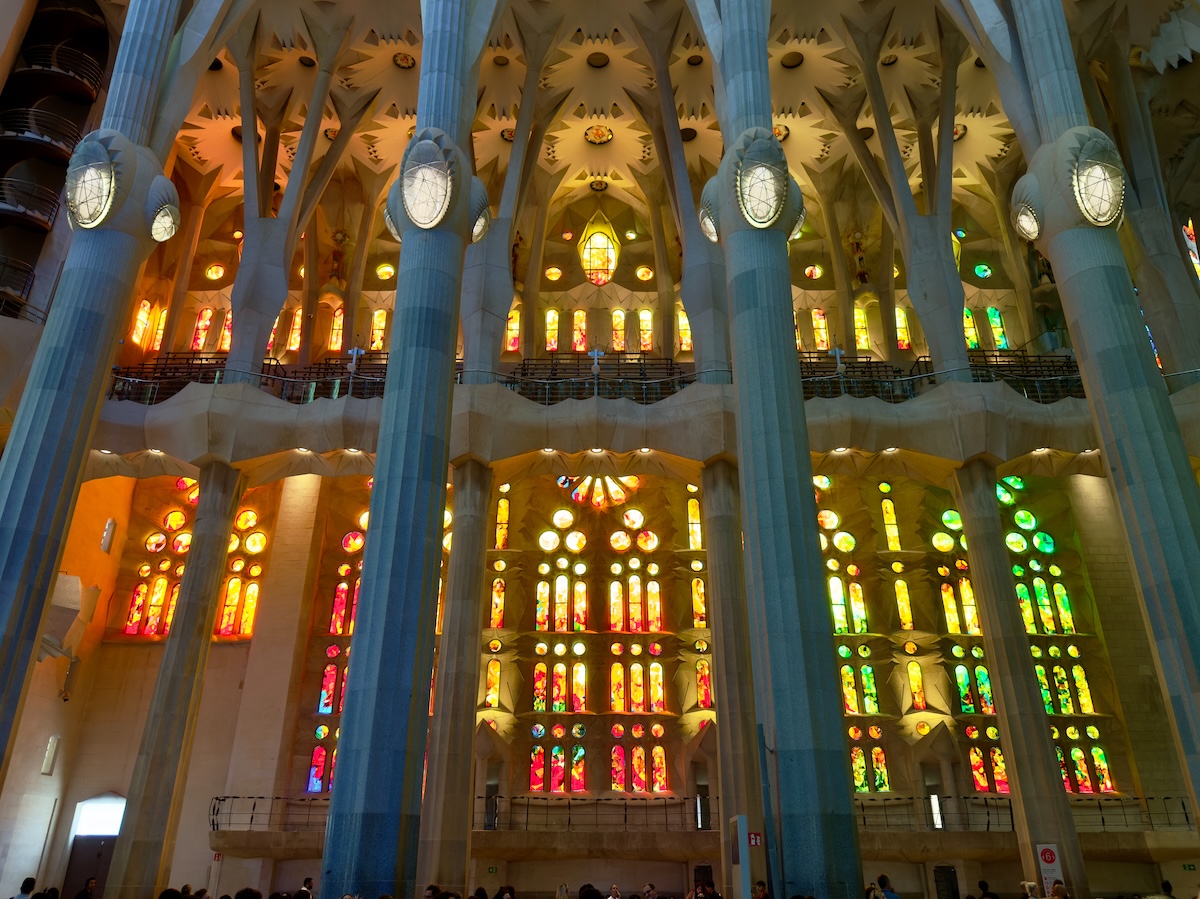
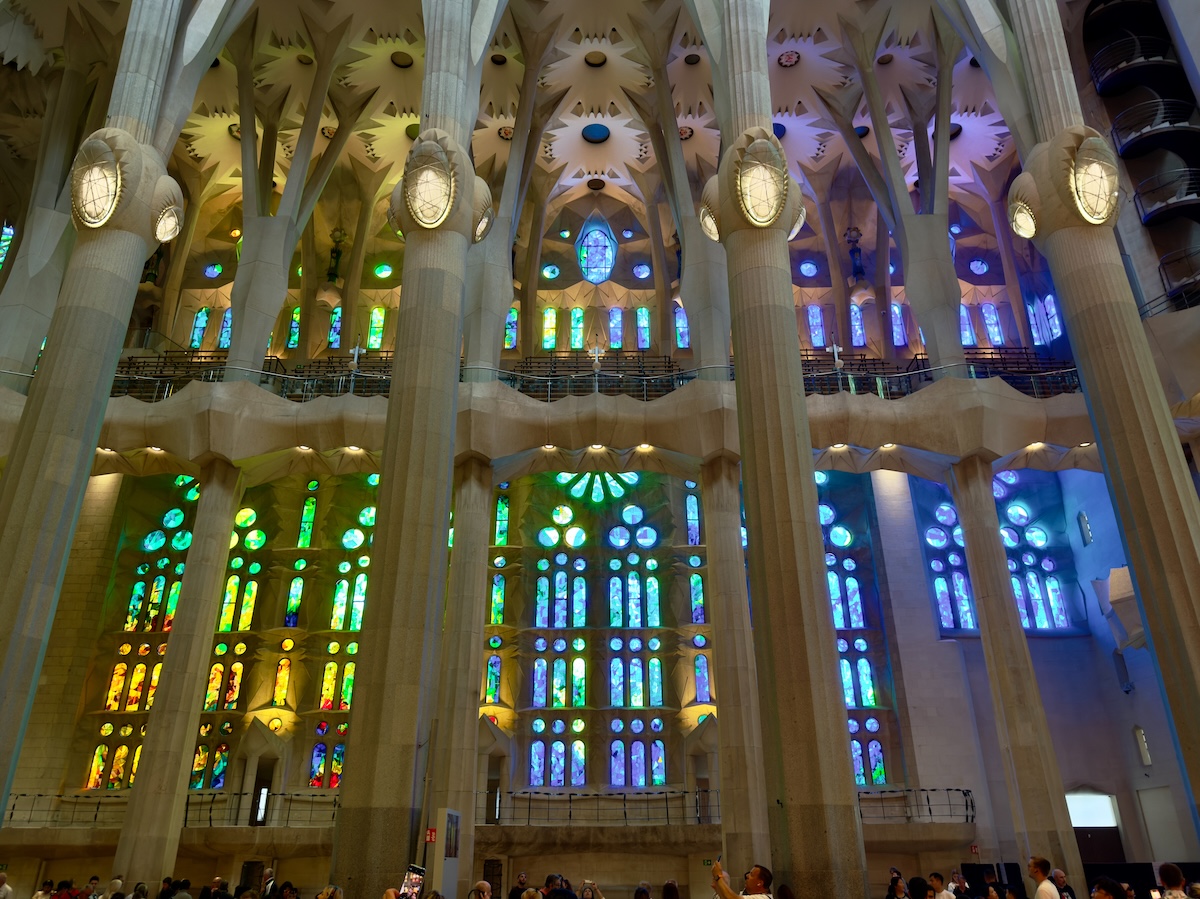
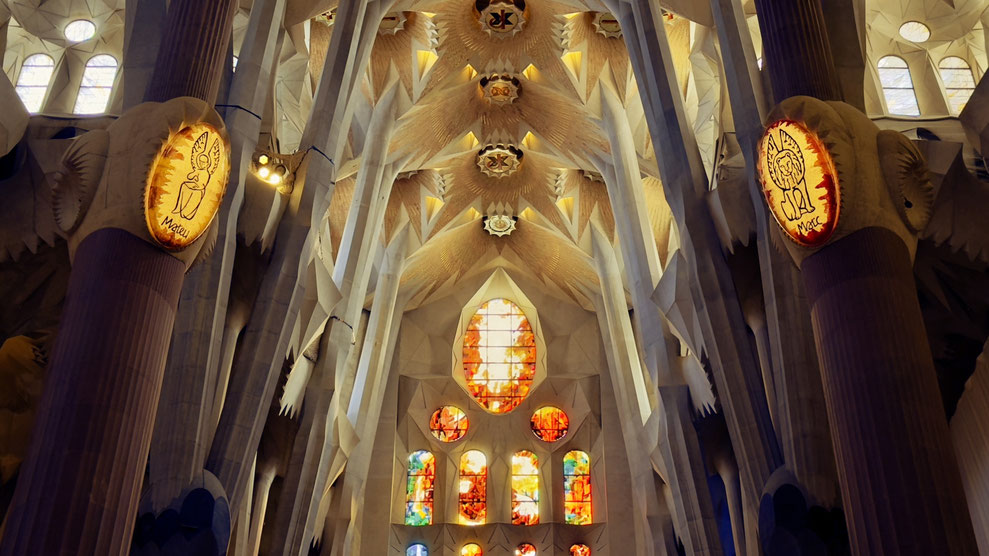
Inside, the scale swallows you. Gaudí wanted the interior to feel like a forest, and it does—columns branching like tree trunks, vaults overhead forming a canopy. Stained glass braids the daylight into shifting bands of color. St. George, the patron saint of Catalonia, is woven into the imagery. The altar sits under a suspended figure of Christ, framed in warm light that spills down from hidden sources. Gaudí was obsessive about light, believing it was the closest thing to God humans could touch.9
It’s the kind of space you want to linger in, but we didn’t have much choice in the matter. Our guide kept us moving, rattling off facts while waving us forward through the crowd. The tour felt like speed-dating with architecture—two minutes of intense connection, then off to the next column, the next saint, the next metaphor. It’s hard to tell a guide on the clock to hold up while you reverently absorb the way a shadow shifts across the nave floor.

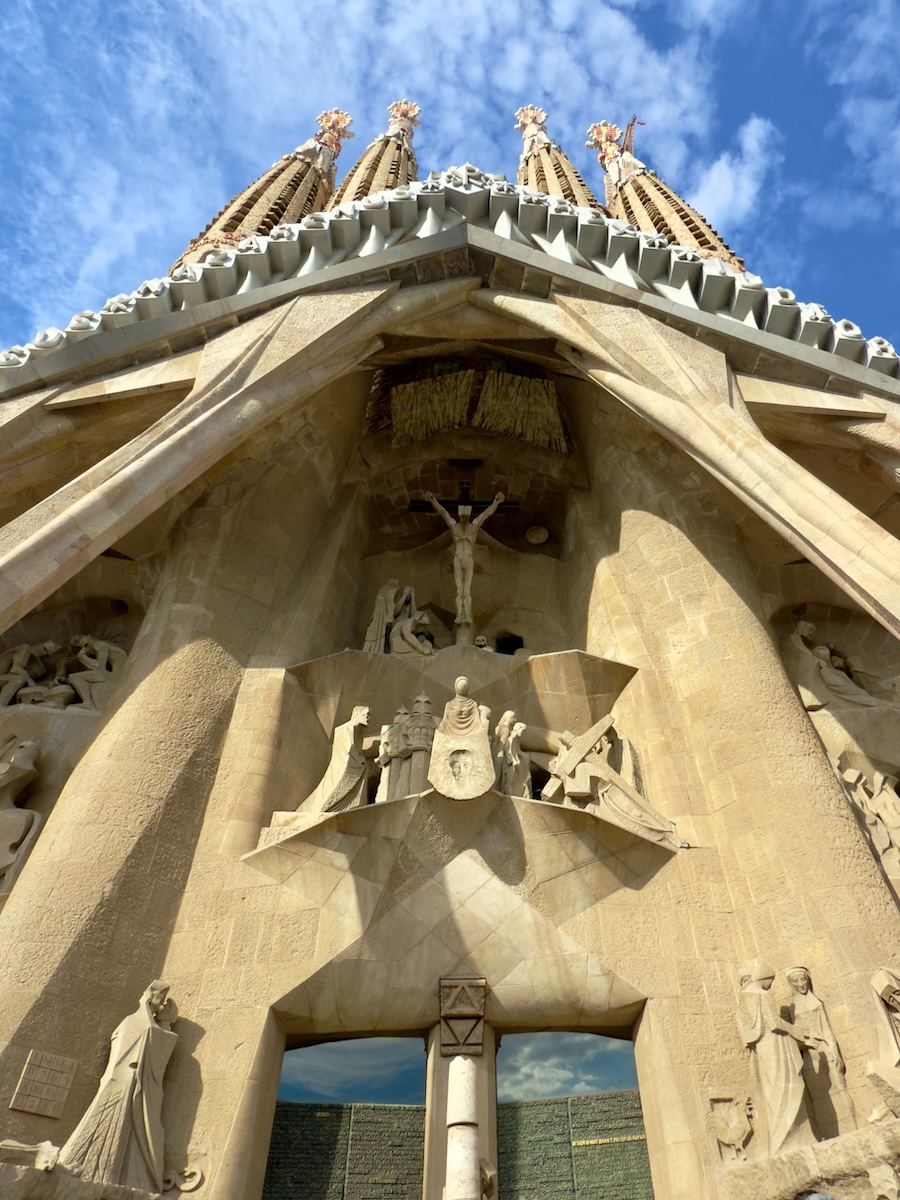
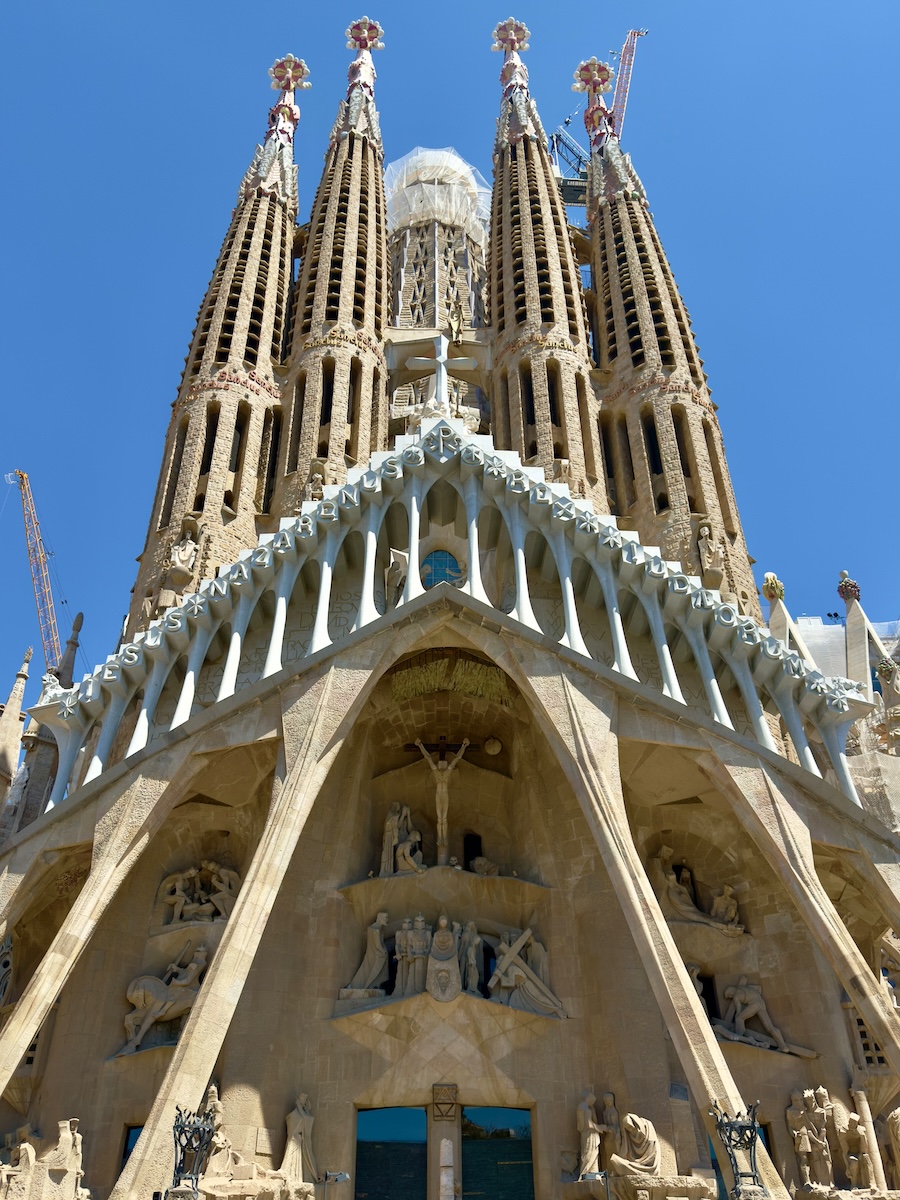
From there, we left through the western doors to the Passion façade. The difference in tone is immediate. Where the Nativity is lush and layered, the Passion is stripped and severe, as if all the warmth had been carved out on purpose. Gaudí never saw this part of the basilica. When he died in 1926, struck by a tram on his regular walk to work, only the Nativity façade and the crypt were finished.10 Work on this side didn’t begin until 1954, nearly 30 years later, under the direction of Francesc de Paula Quintana, who had spent much of his life preserving and interpreting Gaudí’s surviving plans. The sculptural program came even later. In 1986, the modernist sculptor Josep Maria Subirachs was brought in to carve the scenes of the Passion—Christ’s last days rendered in stark, angular forms that made half the city furious and the other half ecstatic. He finished in 2005. Gaudí had insisted that future artists should follow his lead but not imitate his style exactly. Here, you see that philosophy in stone—a different voice telling the same story.
Just a couple of days later—and owing to Krista’s massive FOMO—I went back. This visit was much more leisurely. She was still learning the choreography of crutches—pivot, plant, curse, repeat. This time, we stuck to just circling the basilica on the outside. Barcelona’s sidewalks already seemed like enough of an obstacle course, what with curbs, cobblestones, and scooters. The crowds, steps, and ramps of the church looked like Mt. Everest, and we were in no shape to summit anything.
We started (again) on the Nativity side, which felt much calmer this time. Maybe it was the slower pace. Maybe it was that we weren't late, lost, or screaming at Google Maps. But the chaos of a few days earlier had evaporated. This time we were able to see many of the small, strange wonders I'd missed before—lizards frozen mid-crawl, sheep looking startled, angels whose toes gripped the ledges. From the corner, you can see how the whole façade tilts slightly upward, like the stone's trying to inhale. Gaudí always said nature was the best architect—and he proved it in limestone.

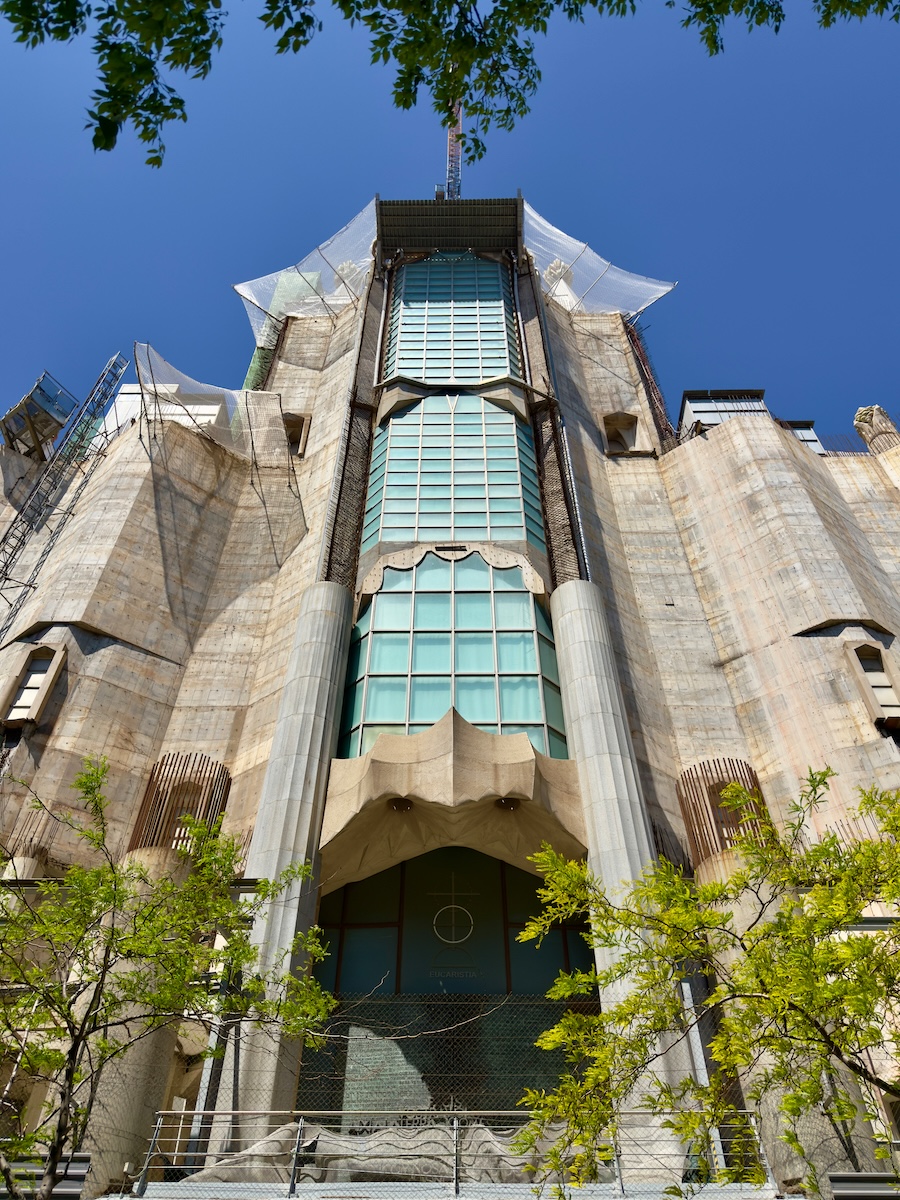
Around the corner, the unfinished Glory façade loomed behind its fencing and tarps. Someday it will depict the road to heaven, but right now it’s the world's holiest construction site. Gaudí imagined the ascent to God as a literal uphill journey—steps rising from street to sanctuary—but at the moment, the only ascent involves scaffolding, and a crane operator named Pau on his third cup of coffee.11 Those cranes swing quietly over the skyline like giant metronomes keeping time for eternity. They looked coordinated, moving in unison. Everything about the Sagrada runs on its own rhythm—slow, stubborn, and immune to deadlines. Even with Krista’s crutches, we could keep pace.
When (if) the Glory façade is ever finished, it’ll become the basilica’s grand entrance—Gaudí’s final crescendo. Plans call for a monumental staircase rising from a garden plaza with greenery, fountains, and seating that would function as both a civic park and a grand public approach to the basilica. A literal stairway to heaven. Fantastic. Though it will necessarily replace those pesky apartment blocks I mentioned earlier.12
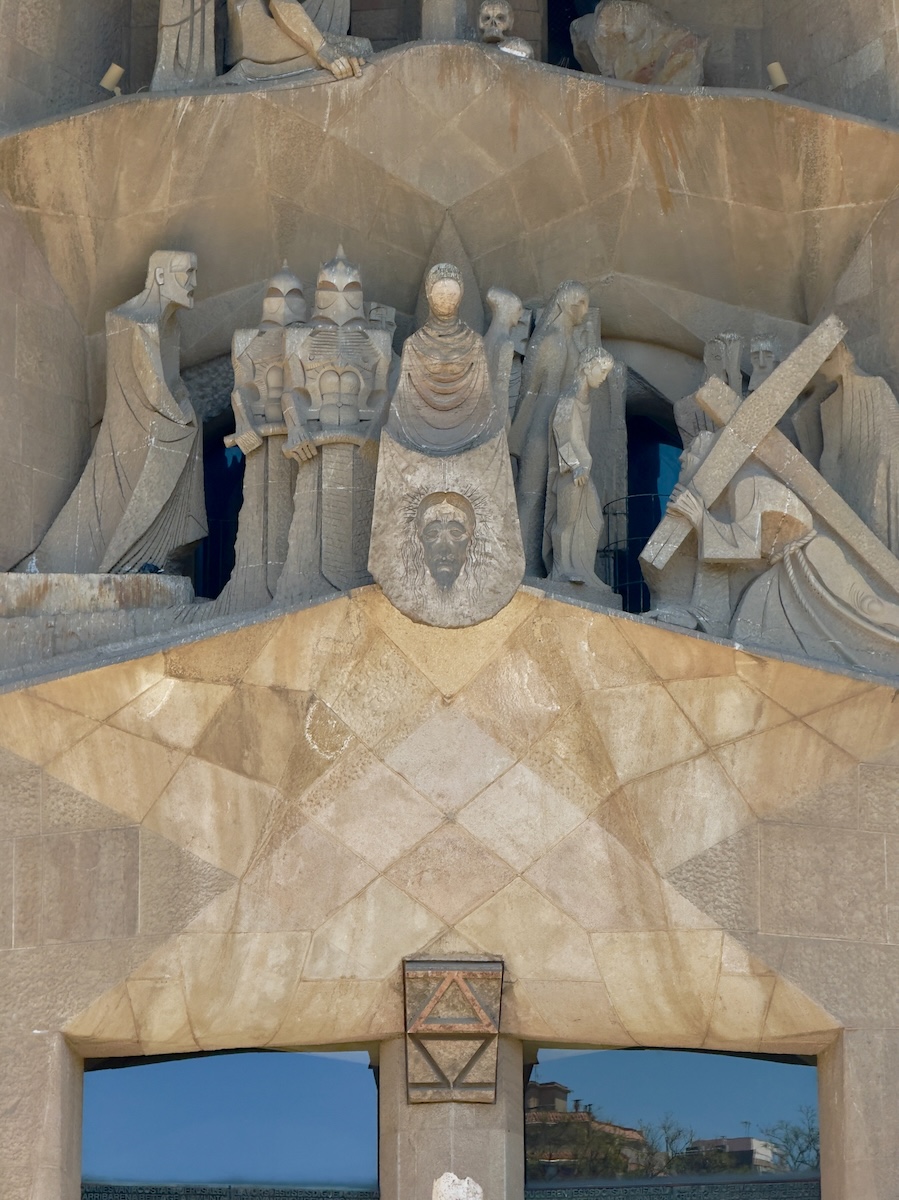
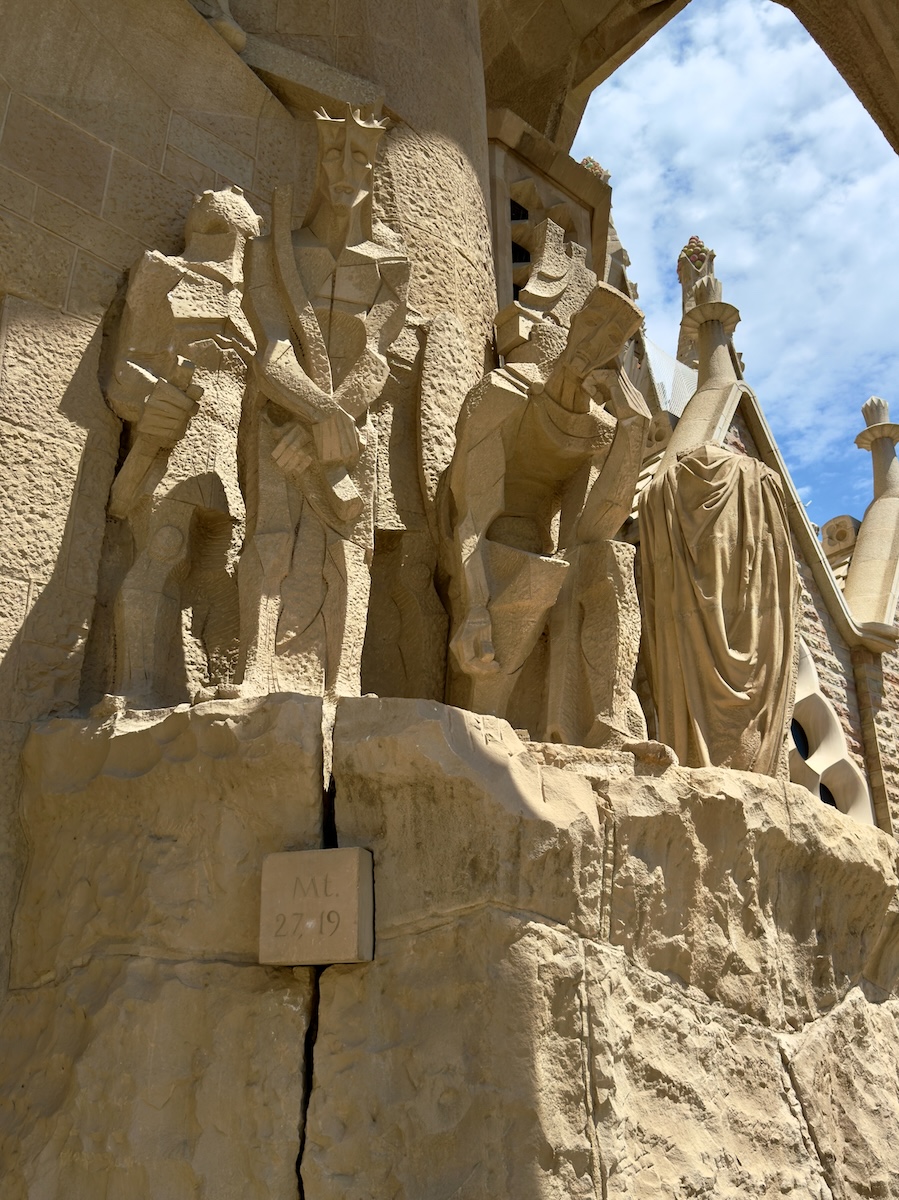
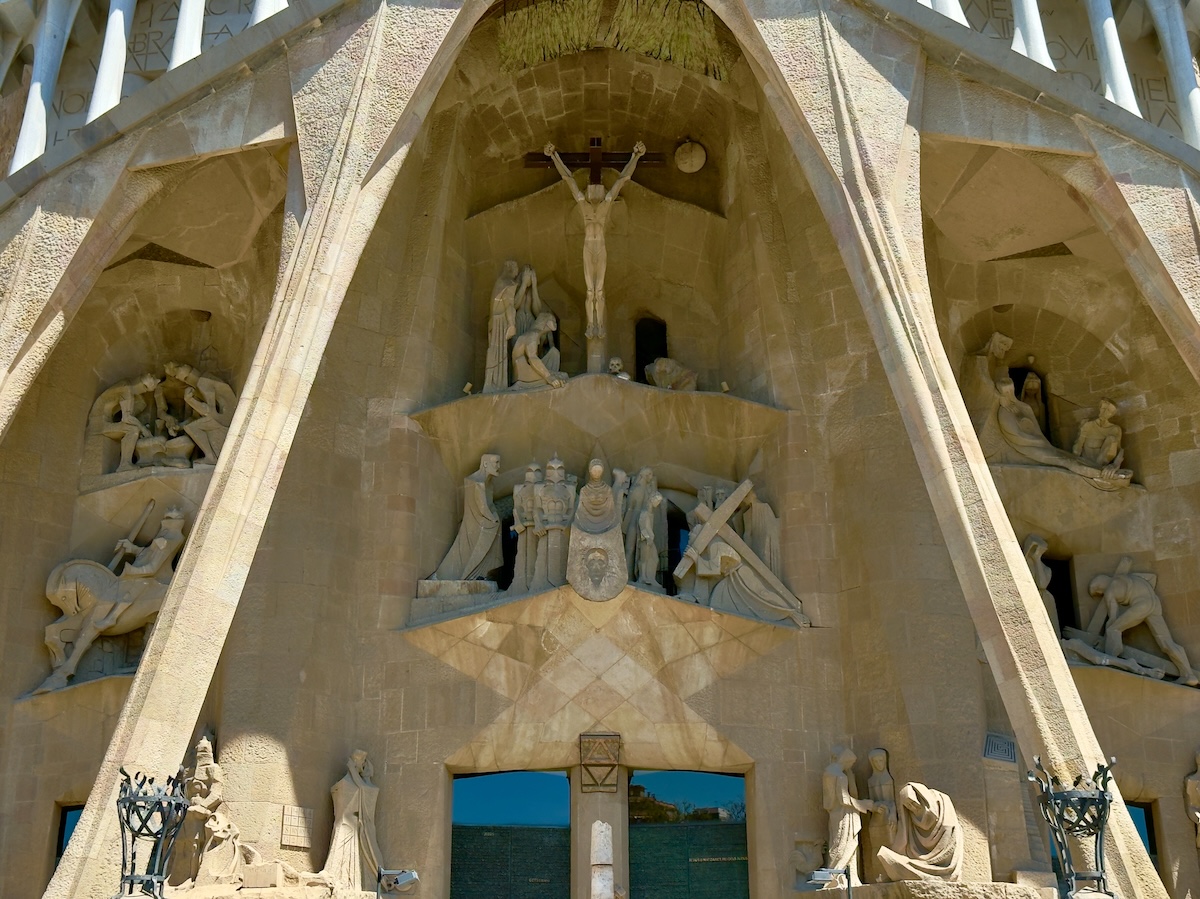
We looped around to the Passion façade, and the light sharpened—the warmth stayed, but the joy drained out of it. Subirachs’ sculptures are sharp enough to give you a paper cut. Gone is the overgrown jungle of the Nativity façade. Here, everything’s been sandblasted down to bare geometry and guilt. Bodies twist under heavy beams, faces hollowed like masks. Christ hangs above them, angular and exhausted, ribs catching the light like blades. Even the rooster from Peter’s denial seems to judge you.
The story unfolds left to right—trial, betrayal, execution—though no one seems to follow it. Tourists fan out like extras in a crowd scene, backing into the pillars for selfies with the crucifix while ignoring the smaller dramas nearby—the whip coiled round the pillar, the kiss of Judas, the magic square that’s an Easter egg for math nerds.13
Just below Christ, between those angular figures, is a moment of tenderness—Saint Veronica stepping forward with her veil. In the story, she wipes the sweat and blood from Christ’s face, and his image appears on the cloth.14 She’s carved mid-gesture, the veil square and geometric, the faint face of Christ pressed into it like a watermark. It’s one of the few scenes here that shows compassion, though even that feels rationed.
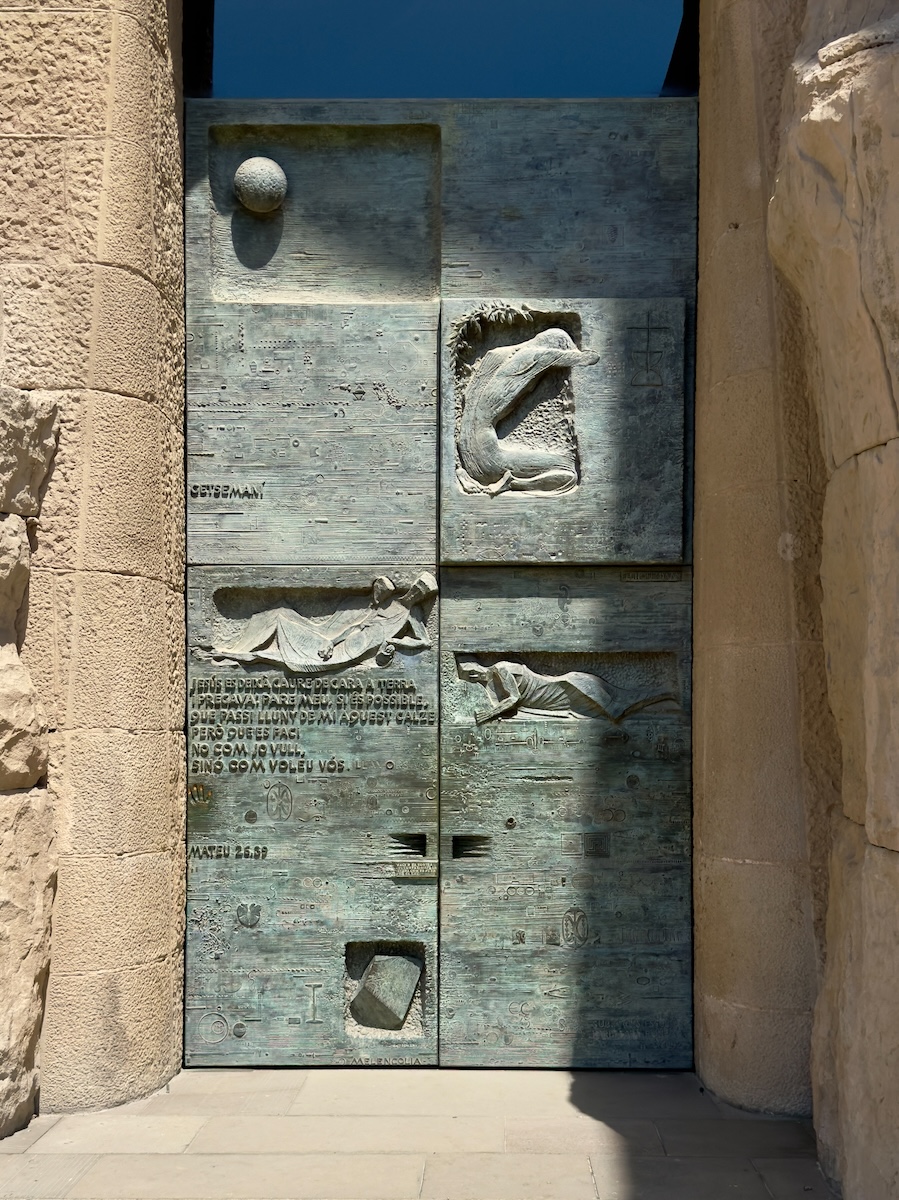
Behind Christ at the Scourging Post, massive bronze doors glint with verses from the gospel—letters carved deep enough to catch both sunlight and fingerprints.15 Run a finger along the words and they press back, as if they’d rather not be read too often. The name “JESUS” stands out in gold, glowing like a spoiler for anyone who skipped Sunday school.
After 20 minutes of sunlit agony and martyrdom, we decided we’d absorbed enough suffering for one day. The Passion façade was heavy—intellectually, conceptually, spiritually—and lunch sounded redemptive. We found a place nearby serving cava by the bottle. Forgiveness pairs well with bubbles.




I thought that would be my last look at the Sagrada. But then I remembered I’d purchased tickets to climb one of the towers weeks earlier—well before I knew I’d have already visited twice. I called, but it turns out divine intervention doesn’t apply to non-refundable tickets. So it wasn't, but a week later, and I was back.
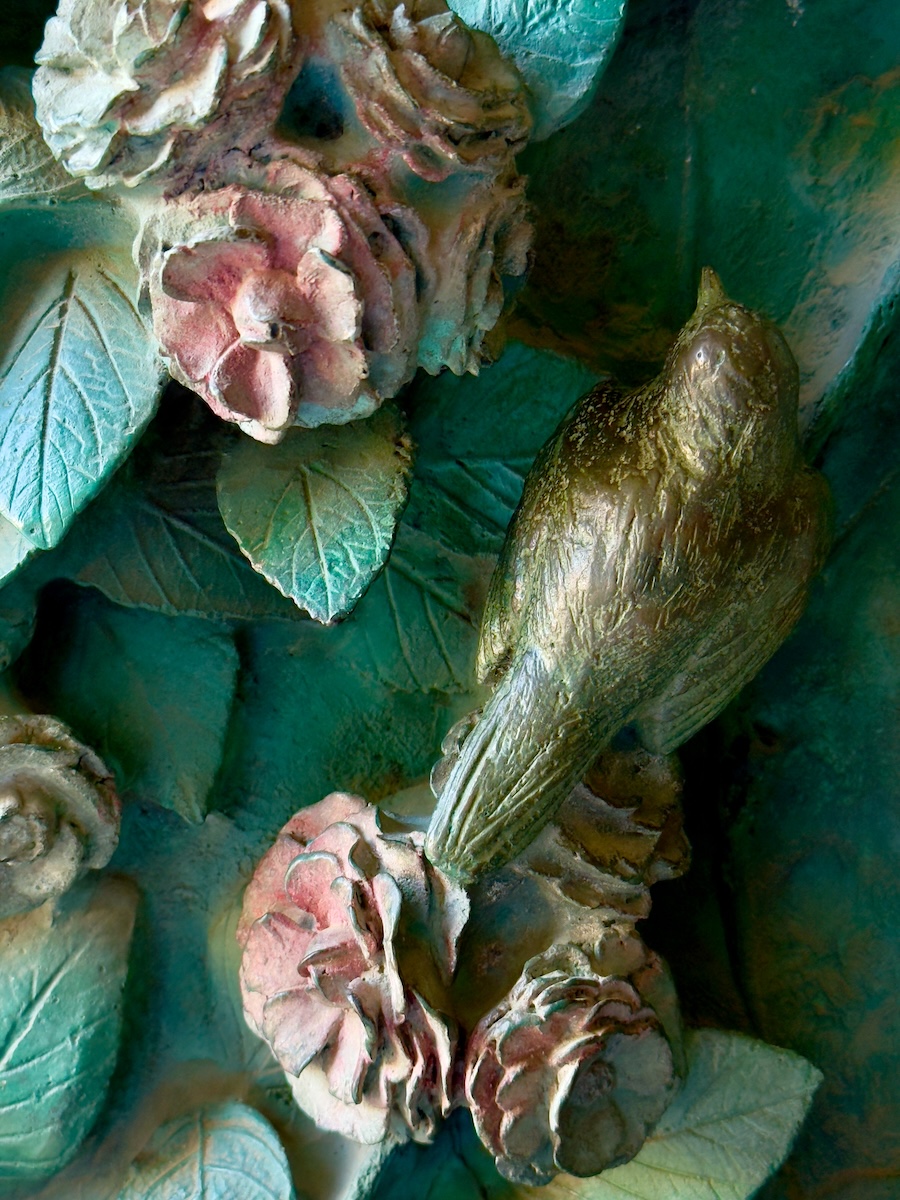
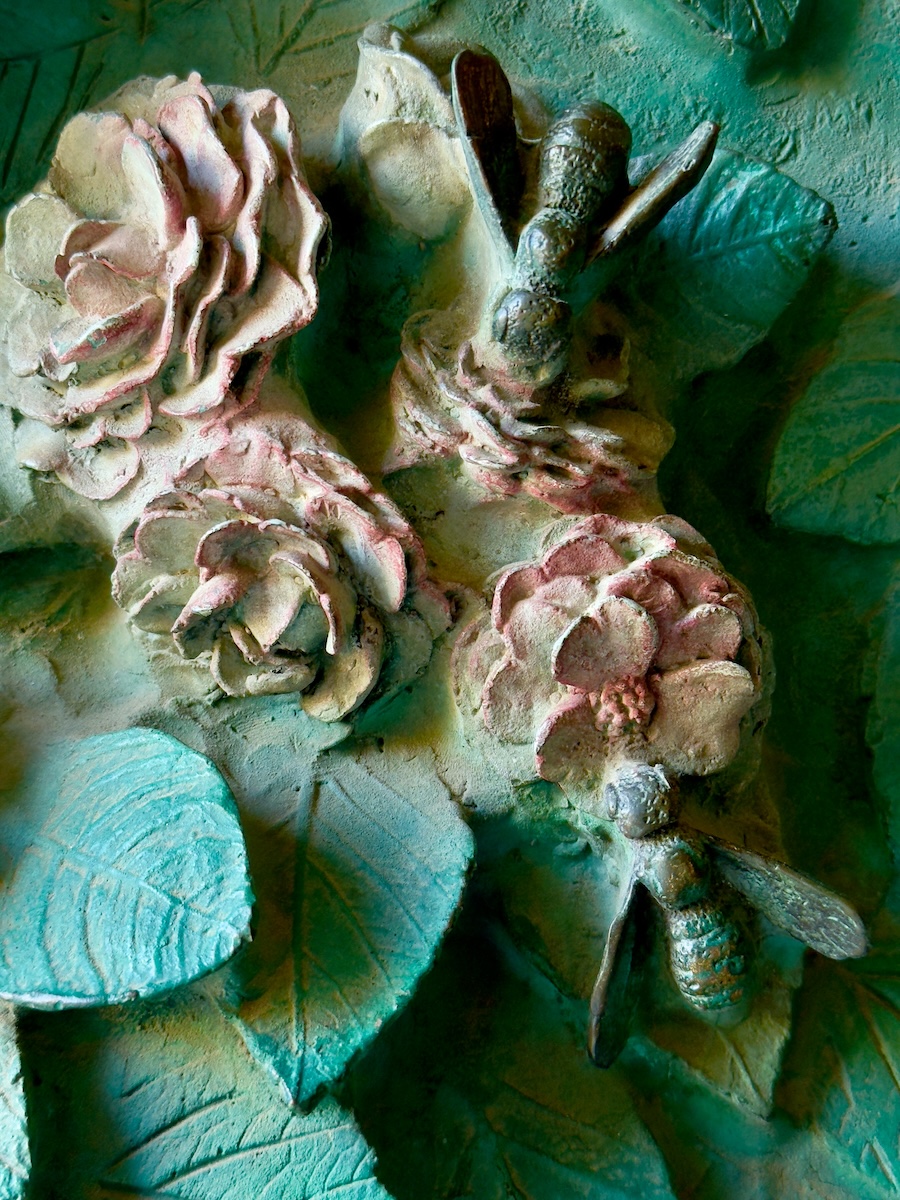
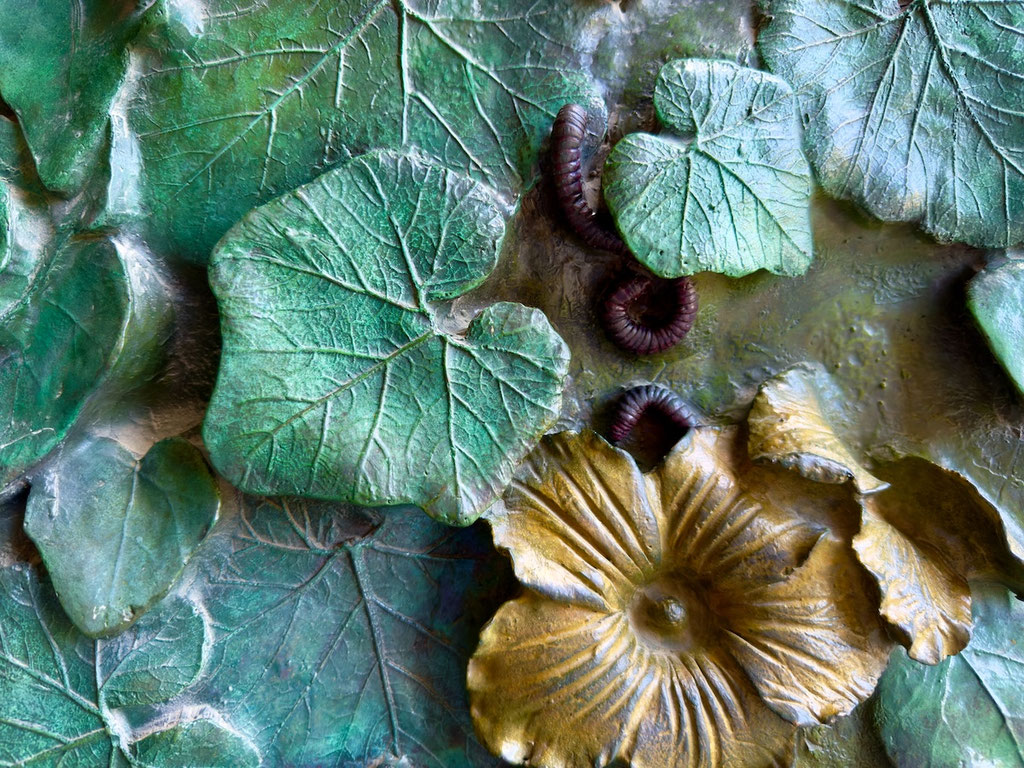
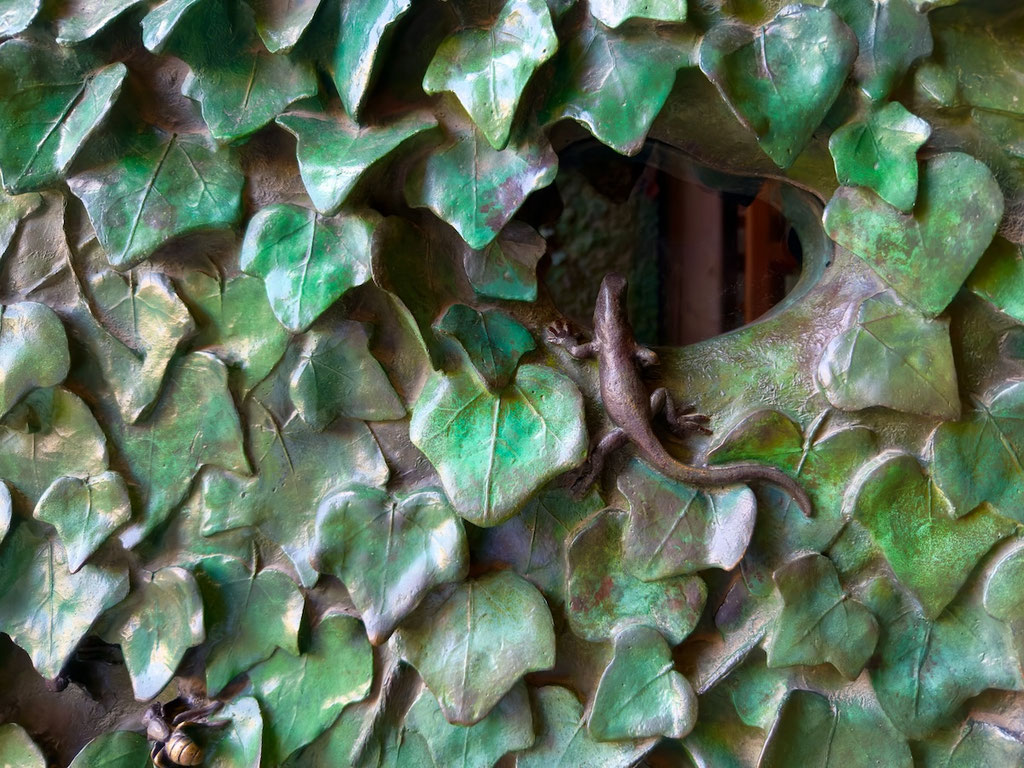
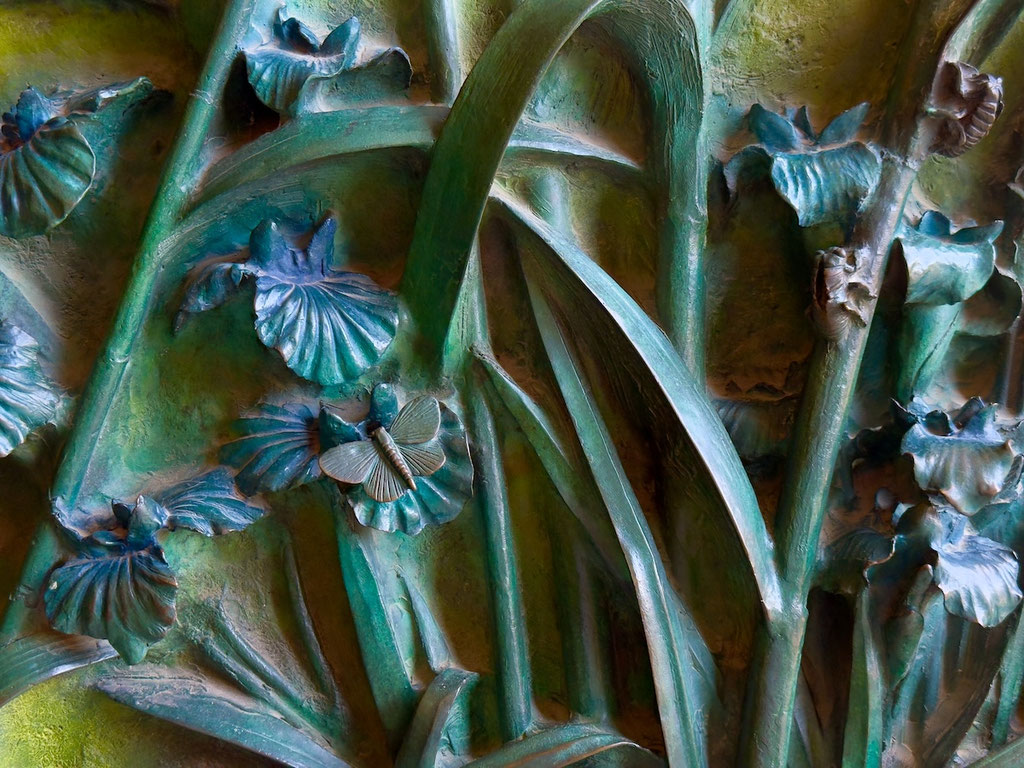
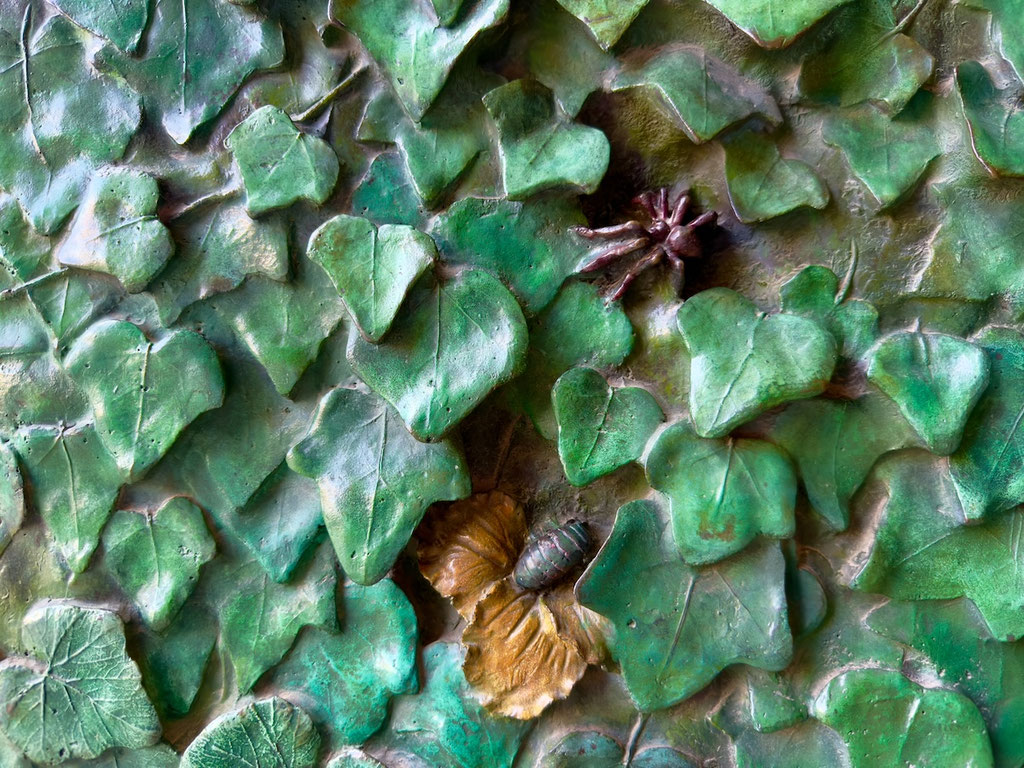
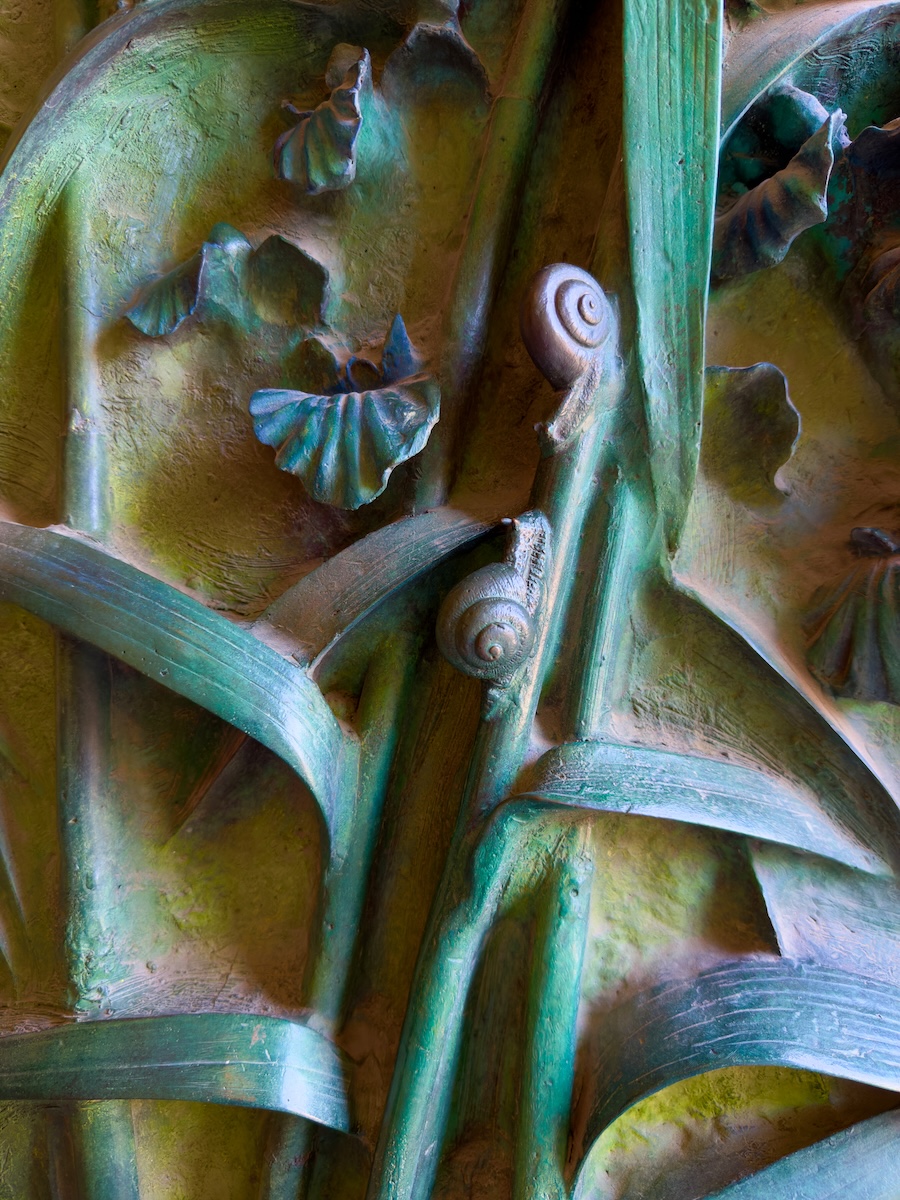
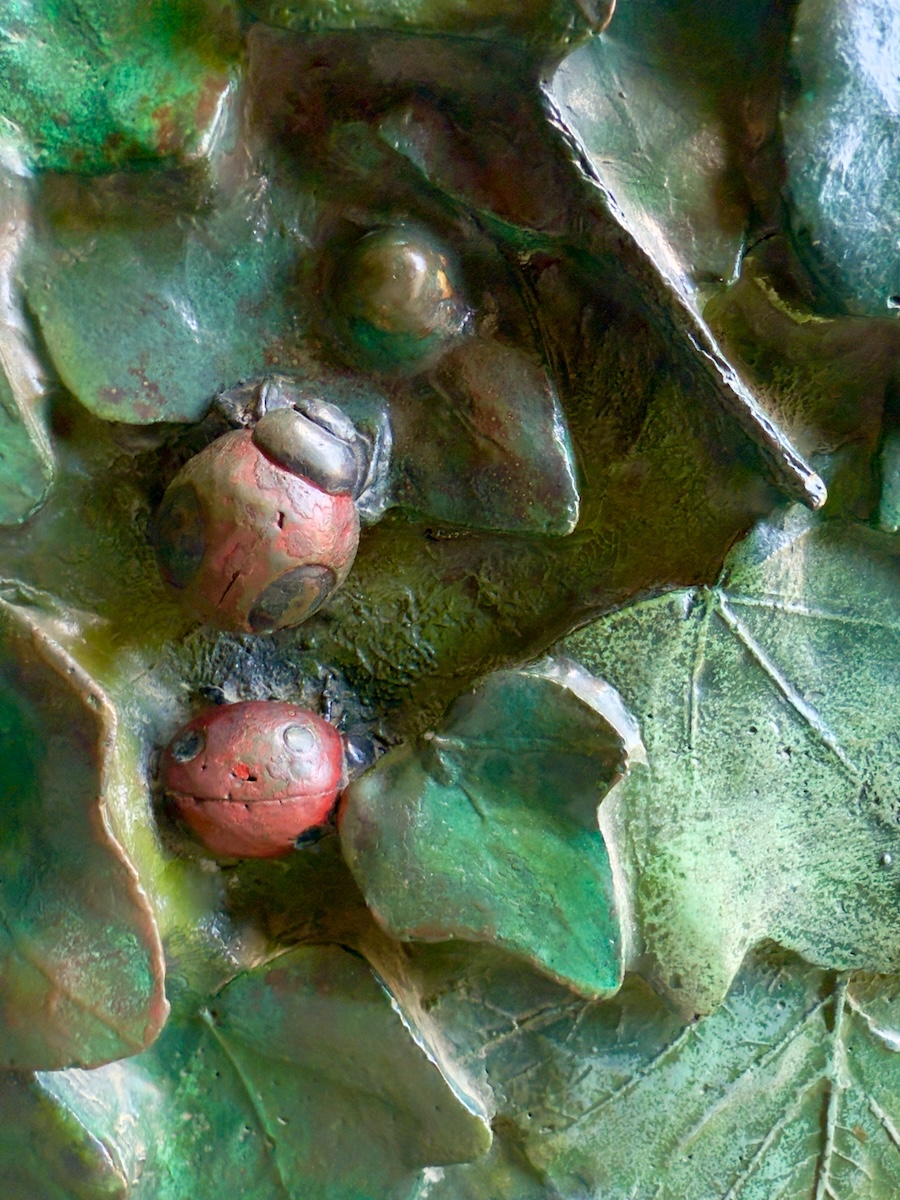
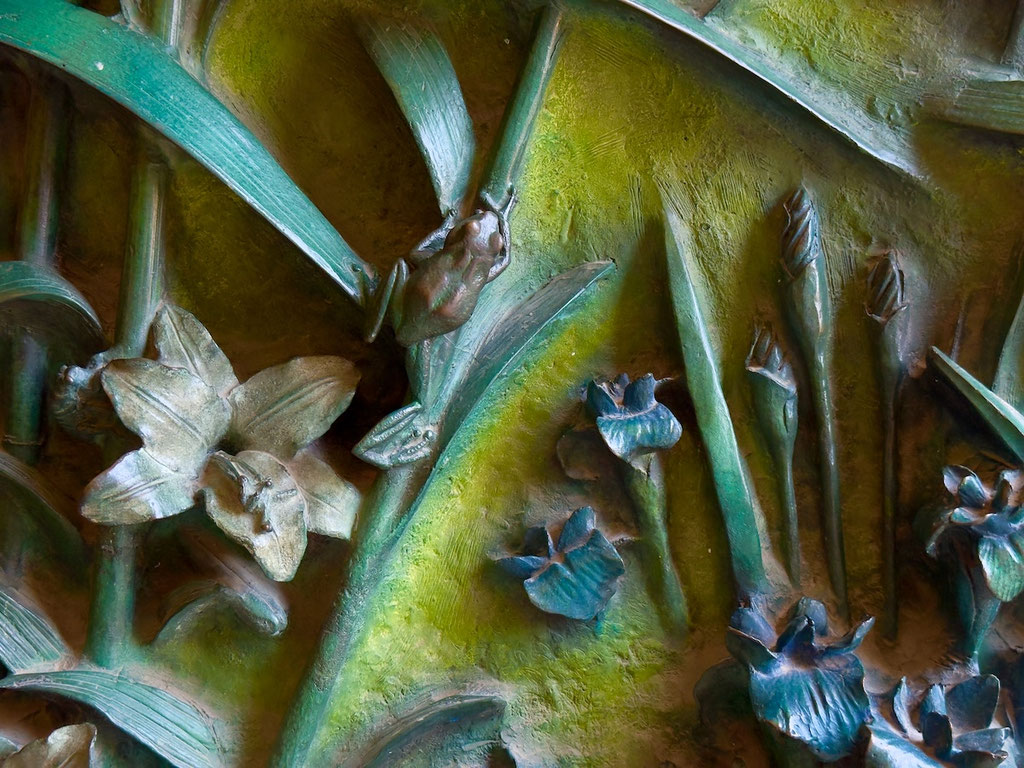
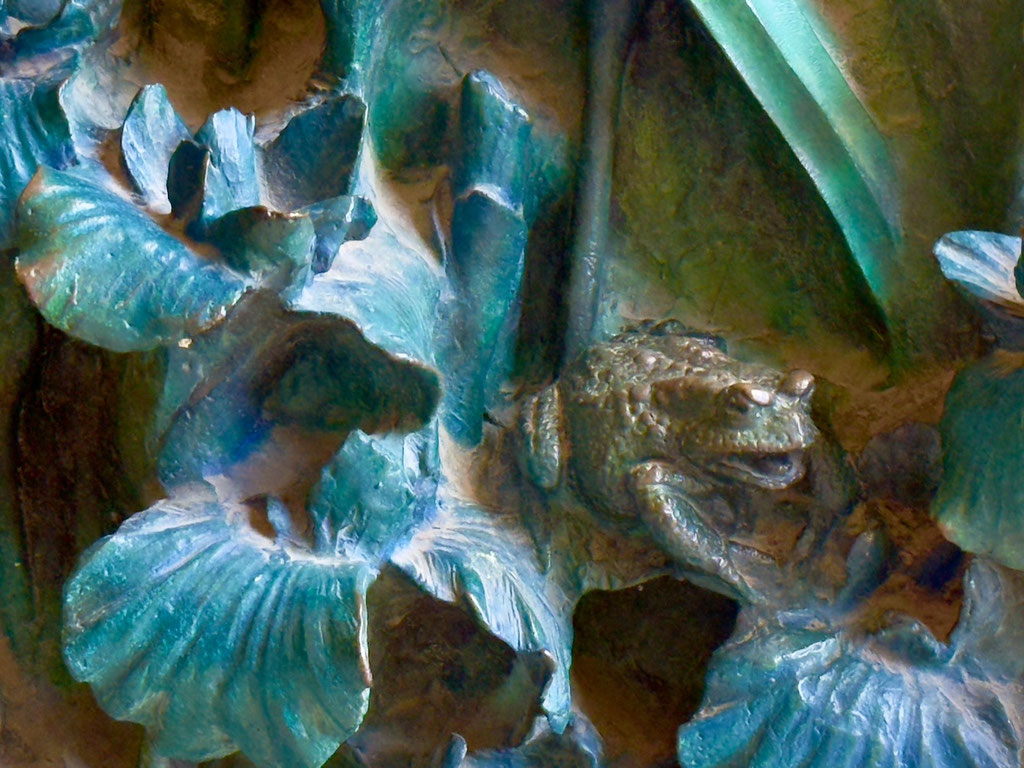
This time, I was on my own—sans Rick, sans Krista, sans guide. It felt almost like starting over, except now I knew what to look for—and what to ignore. I stopped first at the Nativity entrance—the same one we’d hurried through on our first visit. This time, I could stand still long enough to look. The bronze doors here are the opposite of the Passion's in nearly every way. Instead of words, there’s life. Instead of geometric precision, there’s wildness. A writhing, blooming mass of ivy and roses, with birds tucked among the leaves, snails inching up stems, frogs crouched in pools, even millipedes winding through the shadows. Every leaf feels alive, every petal slightly damp, as though the whole thing will keep growing.16
Inside, the basilica was as crowded as ever, but it didn’t matter—you can’t outshout that space. I slipped in alone, the air shifting instantly from street heat to the cool hush of stone. The city vanished behind me. After two previous visits, I knew where to go, when to look up, and which corners tourists tended to clog. Even so, the interior still hits like vertigo. The columns don’t just rise—they lift, as though the whole building were taking one long, slow breath.
Without a guide or a schedule, my eyes could wander. The afternoon light slanted through the windows, rippling across the columns in translucent greens, golds, and reds. On the opposite wall, indigos and violets cooled the room—an architectural mood ring. I remembered what the guide had said about Gaudí designing this place as a forest. She wasn’t wrong, but it also felt like standing inside a living clock—the light marking time instead of hours.
At the altar, the suspended Christ hovered just as I remembered, though now the effect felt stranger, more mathematical than mystical. Every angle of the basilica seems to exist for light to find it. Even the organ pipes shimmered differently this time, reflecting color from the glass like a prism. I lingered, waiting for the next wave of light to shift, which it did—slowly, as if hesitant to move on.
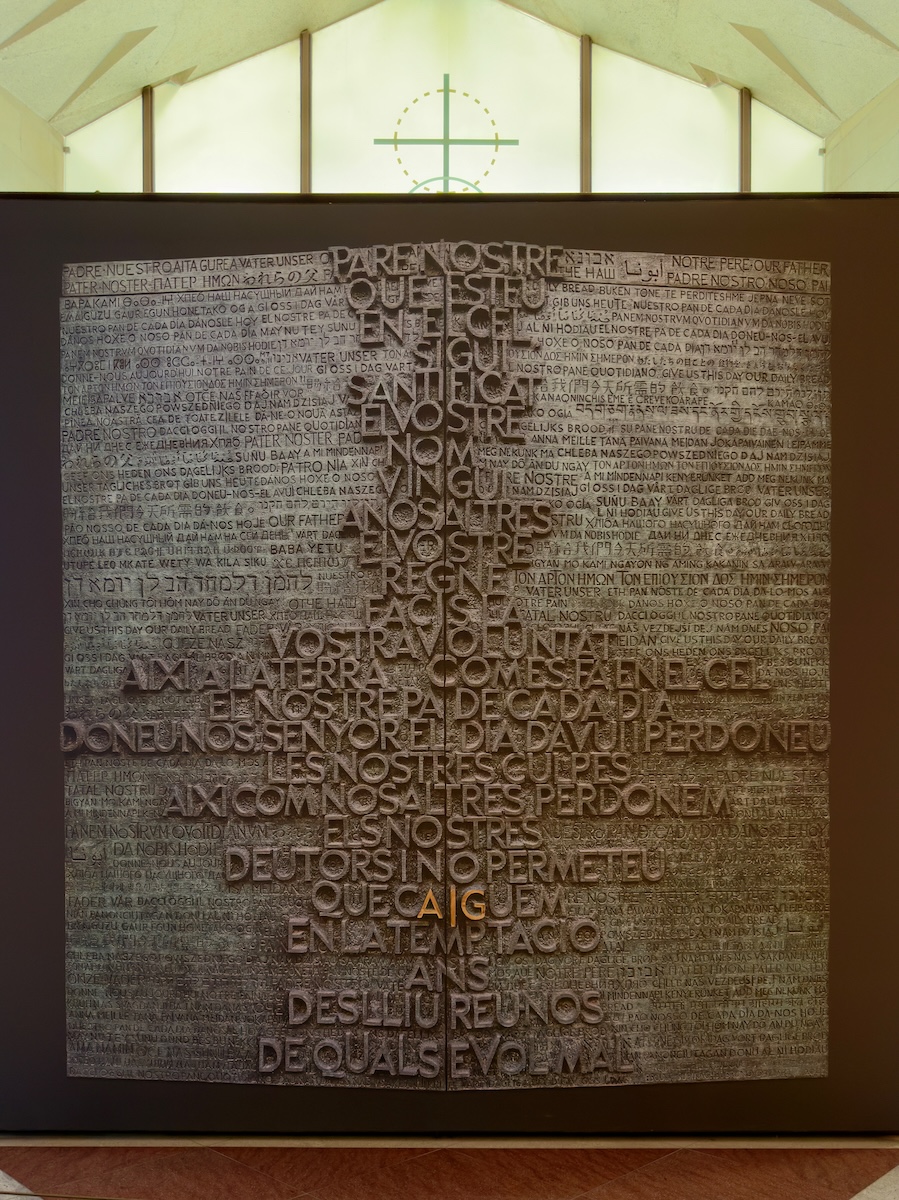
Near the southern exit—what will become the Glory façade—a set of bronze doors glowed with the Lord’s Prayer in an impossible number of languages. You can spot familiar words in the chaos, and many you can’t. In the center, a gilded “A|G”—Antoni Gaudí’s initials—shimmers mid-word, tucked neatly between “deliver us” and “evil.” His monogram lies right where the doors part, as if the architect himself still holds the key.17

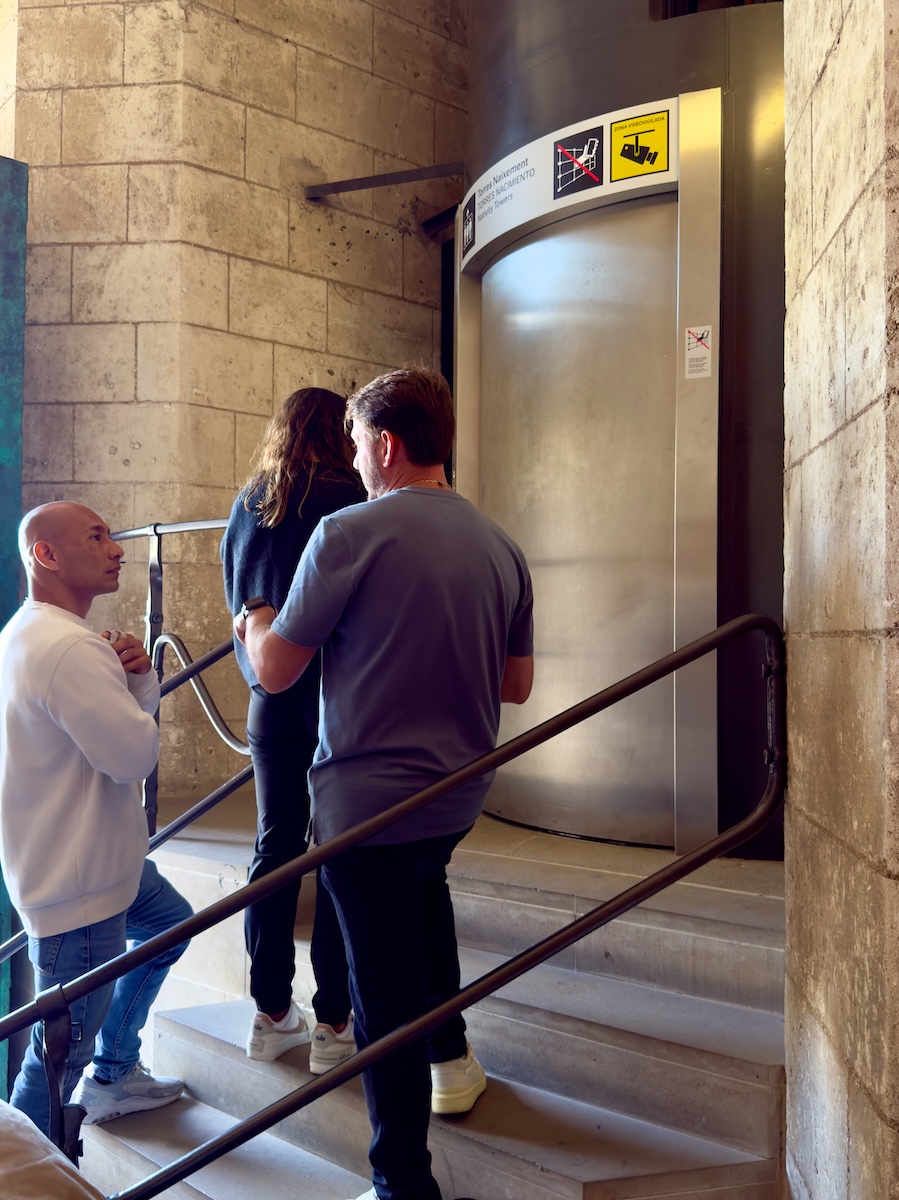
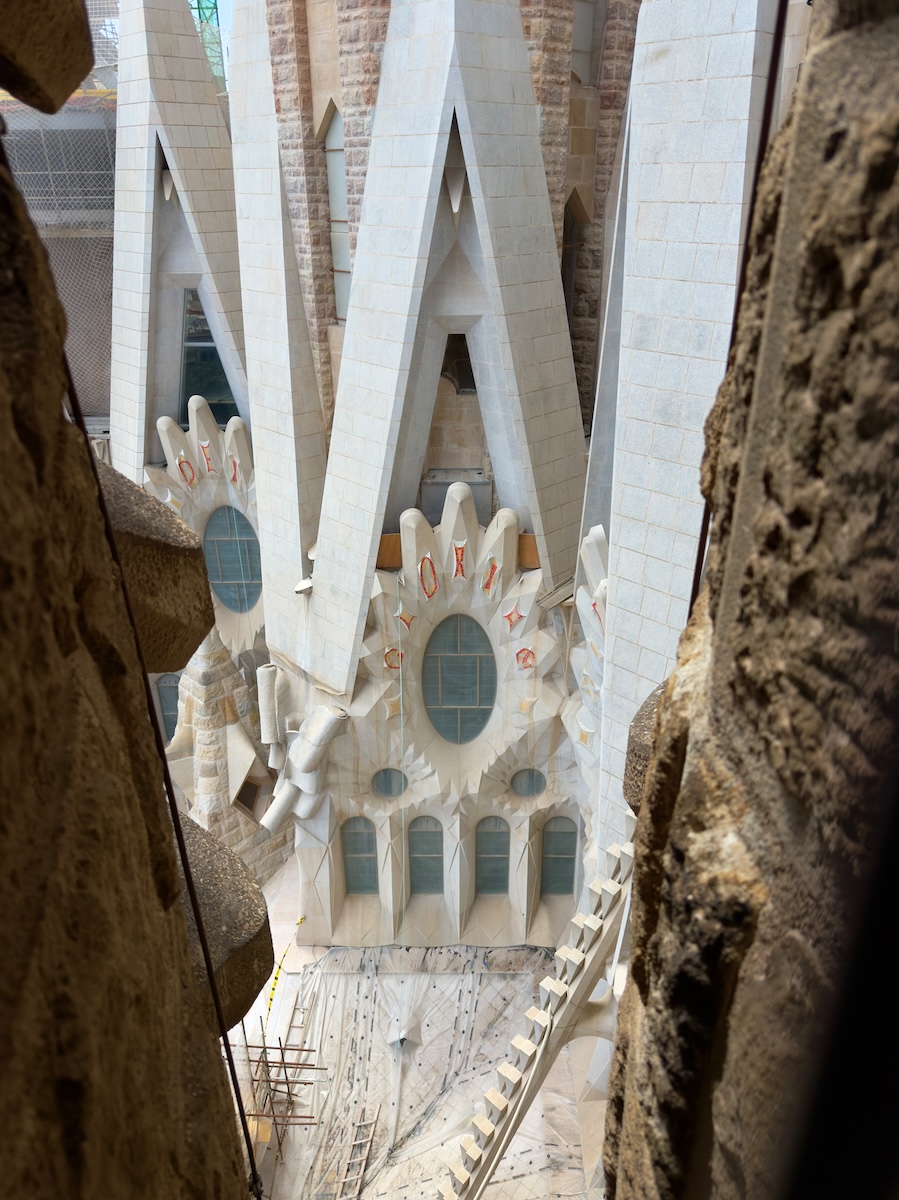
I took a last look at those doors with the gleaming signature before heading off to see how the view looked from closer to heaven. My non-refundable tower climb started with an elevator—thank you, 21st century—and a warning about claustrophobia. A small group of us squeezed inside, and it suddenly felt more like a commitment than a convenience as the doors closed. At the top, we stepped into the narrow spine of one of the Nativity towers. From there, it was a single-file descent spiraling down stairs coiled like a nautilus shell through small windows and long shadows.
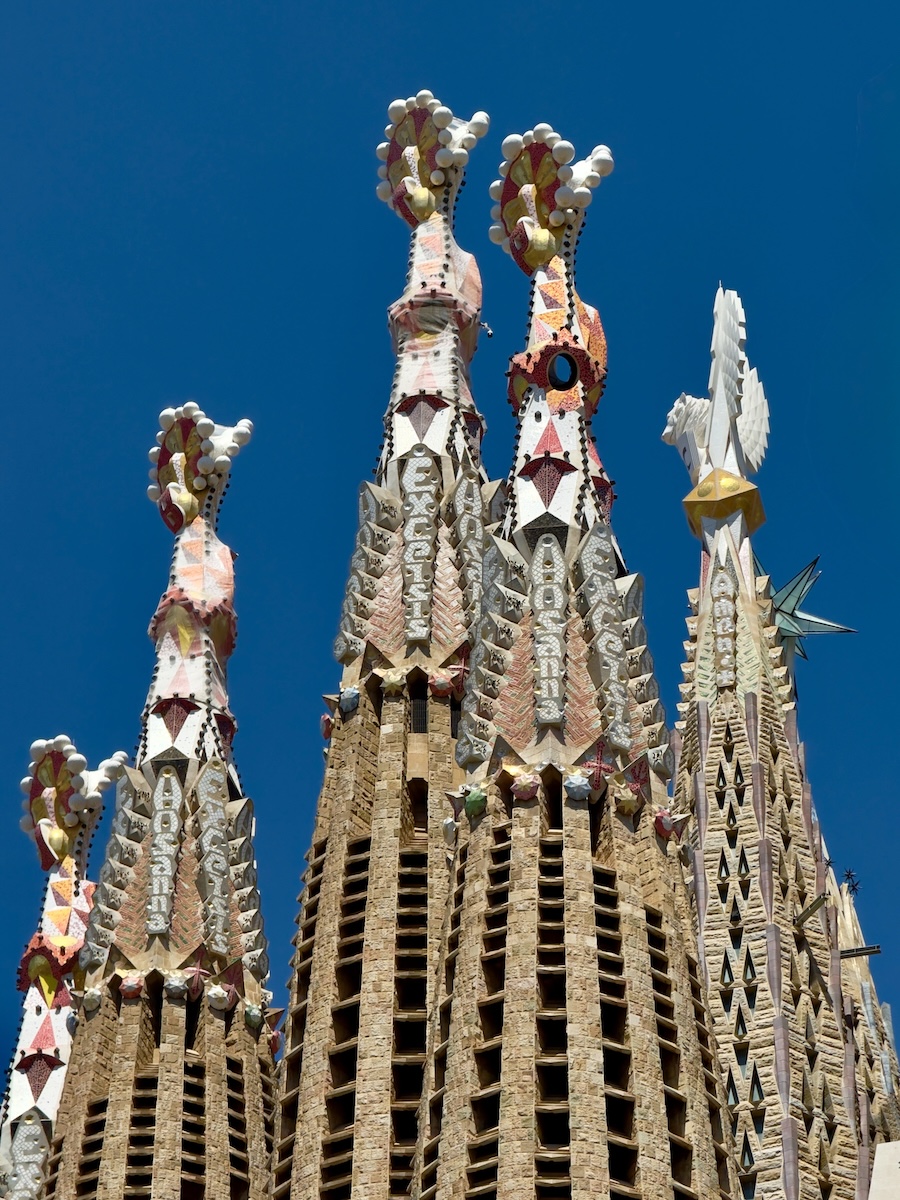
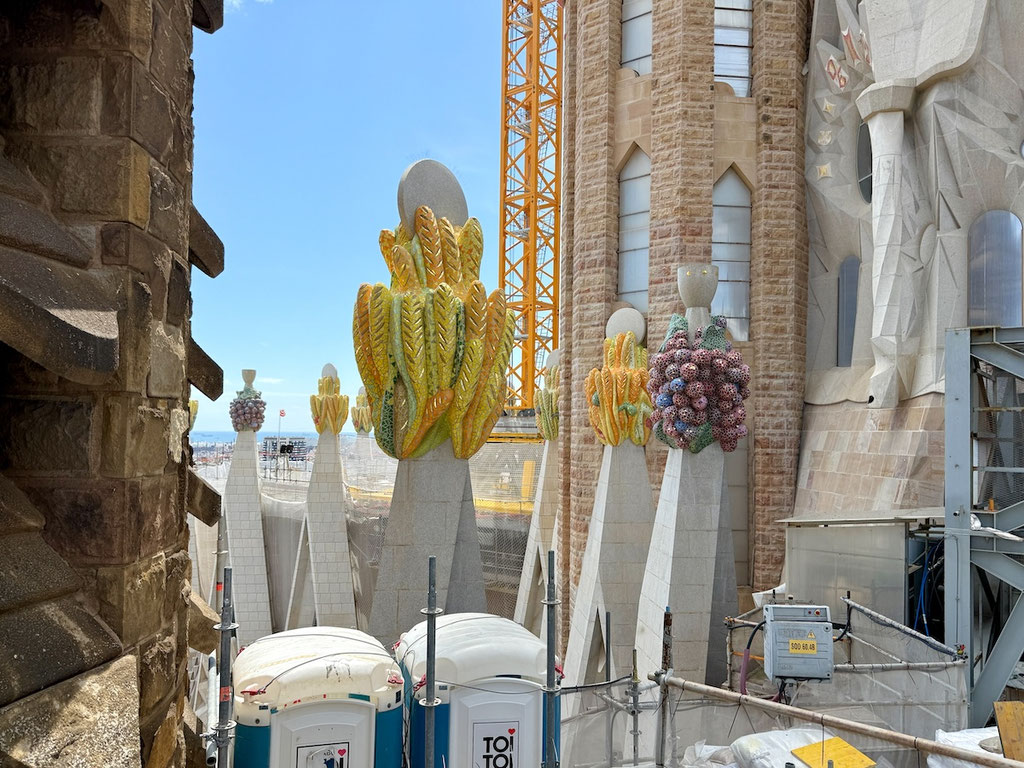
From the landings, you can see the city unfurl—the Eixample grid stretching to the sea, the Mediterranean flickering in the distance, those doomed apartment blocks. Fruit-topped spires were suddenly close enough to study up close—grapes, wheat, pomegranates, and figs glazed in brilliant color. Like a religious centerpiece designed by someone who thought the Garden of Eden just needed more fruit and better lighting.18

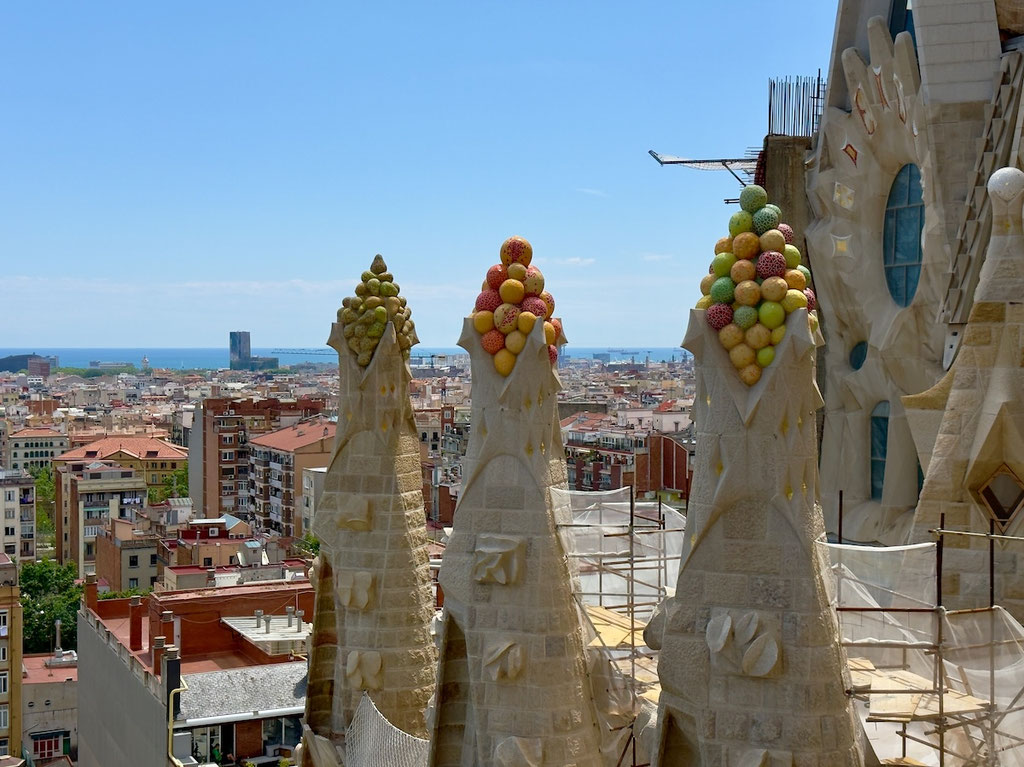
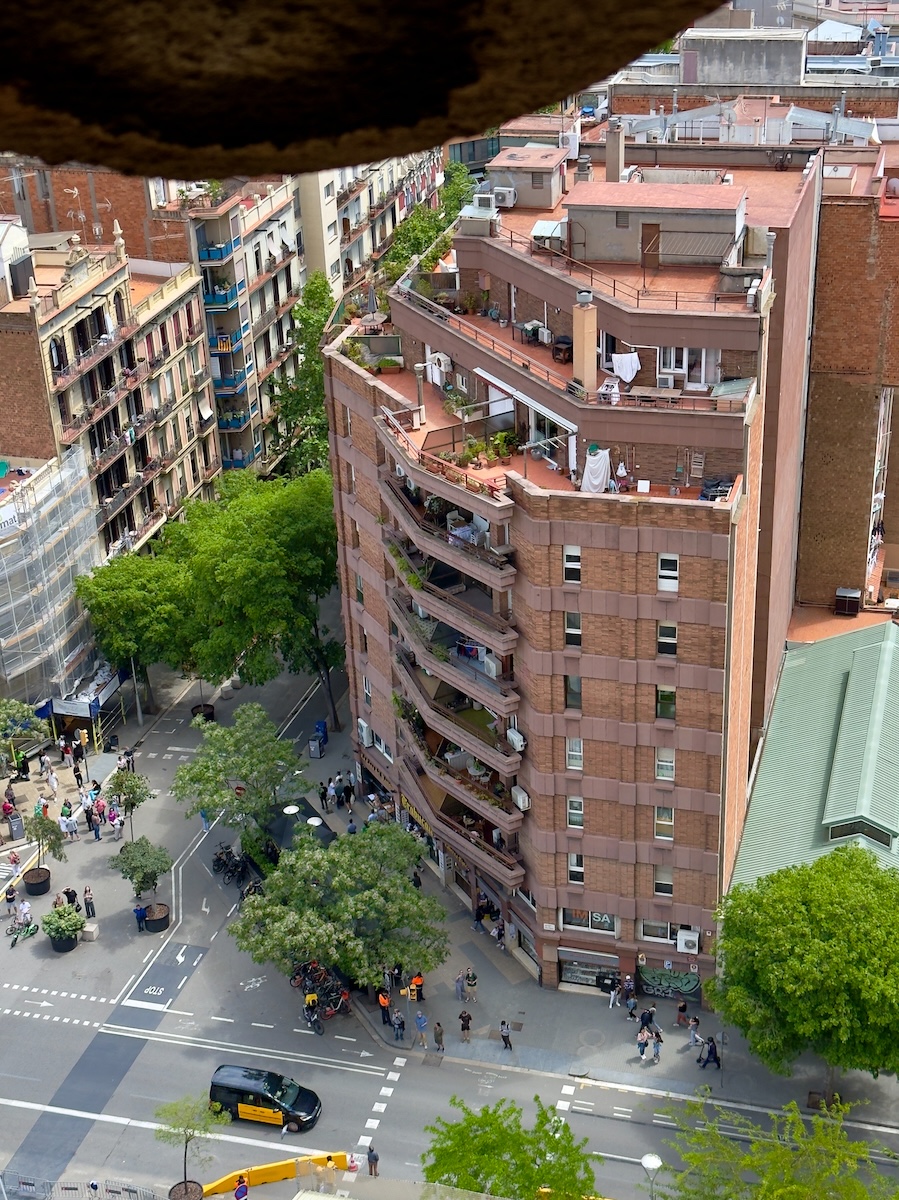
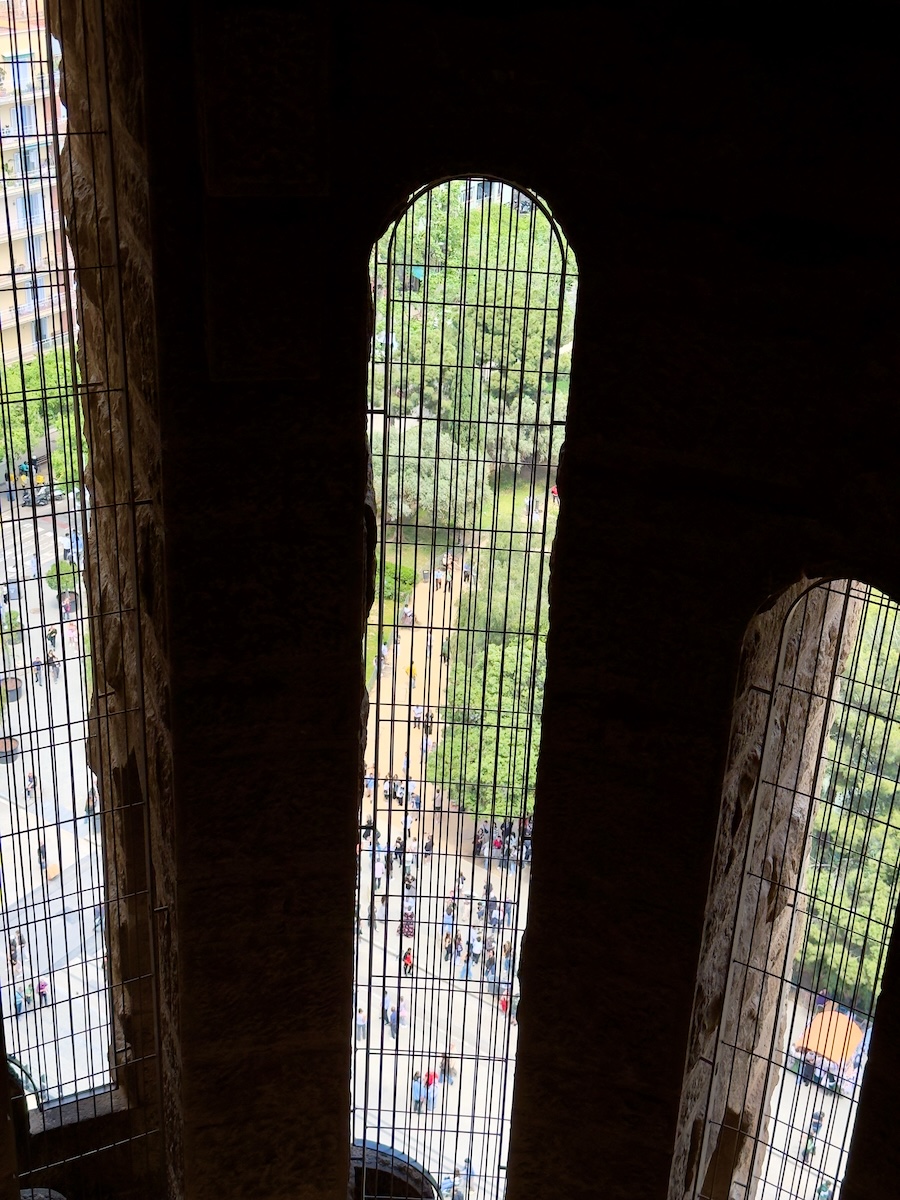

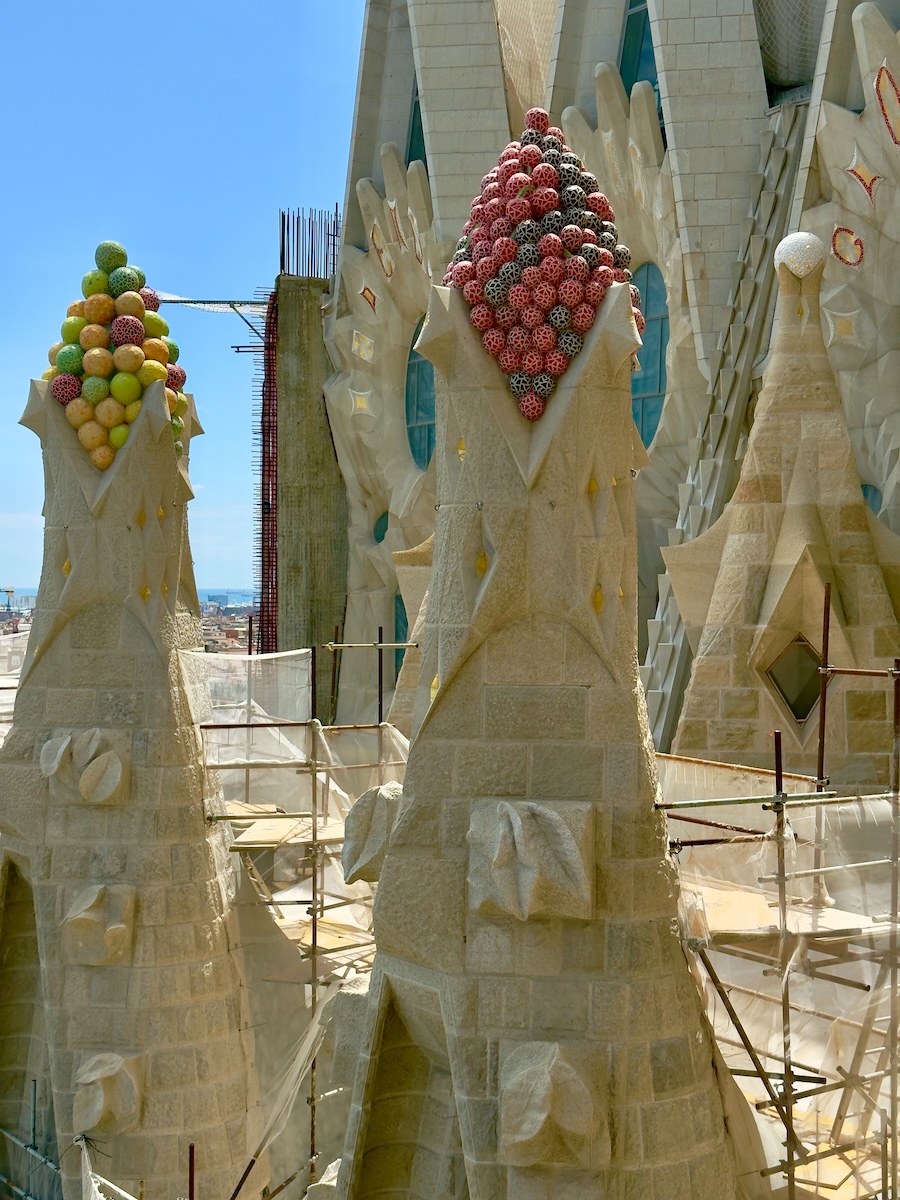
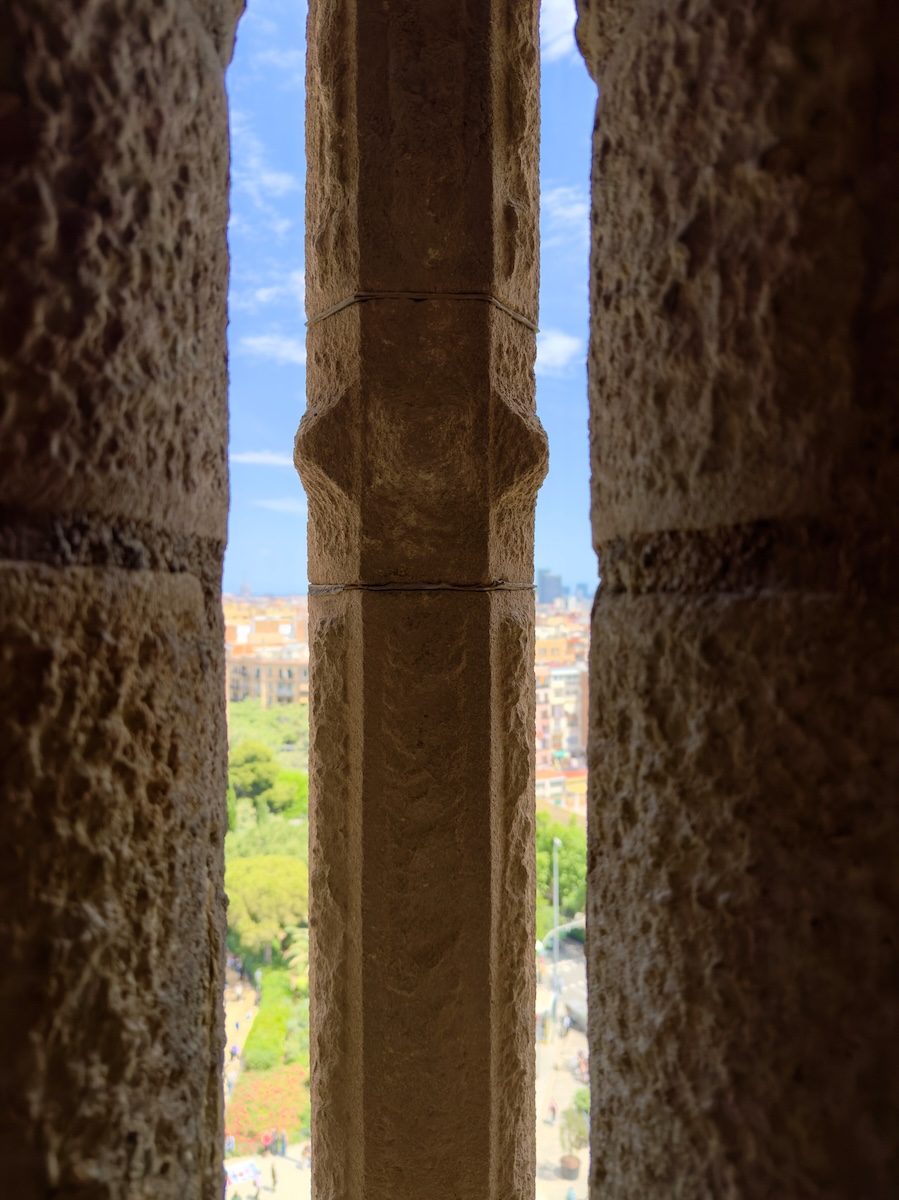
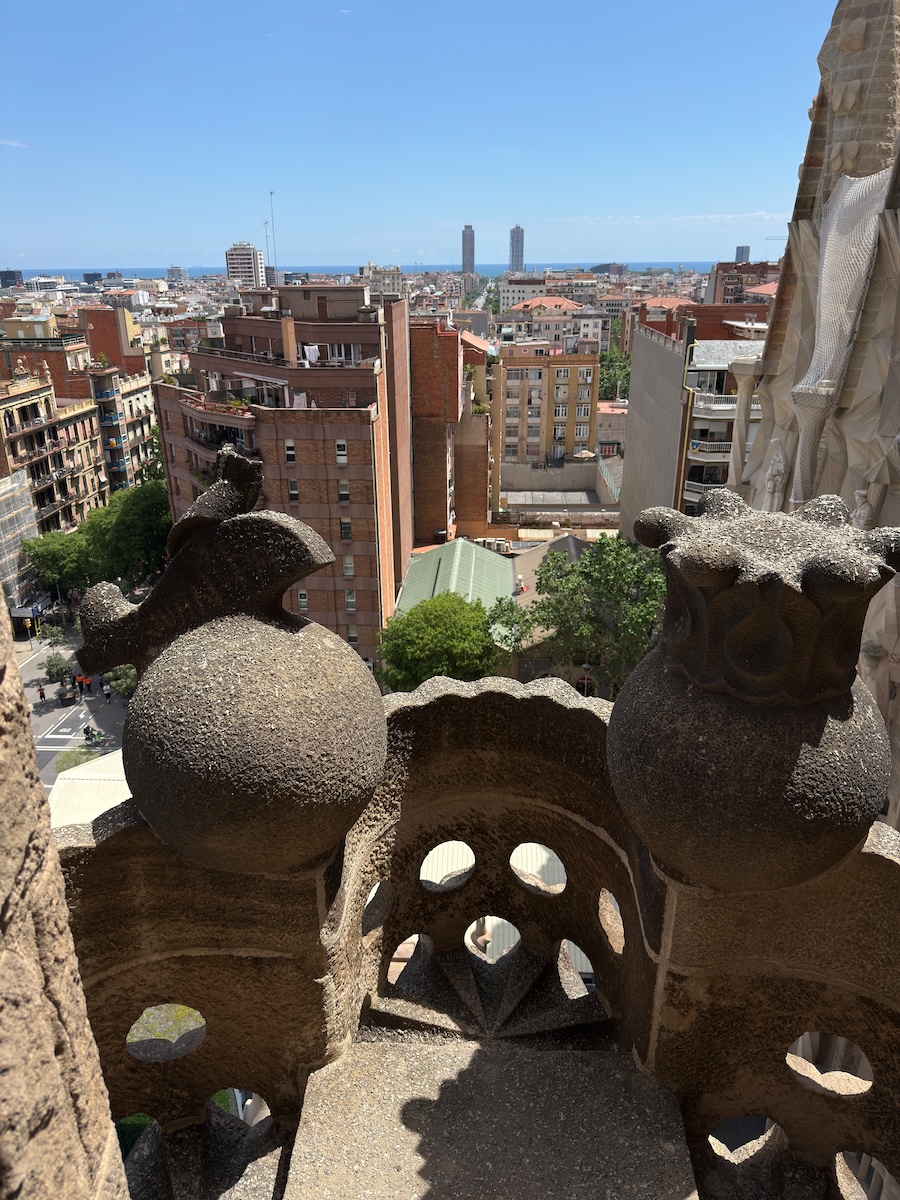

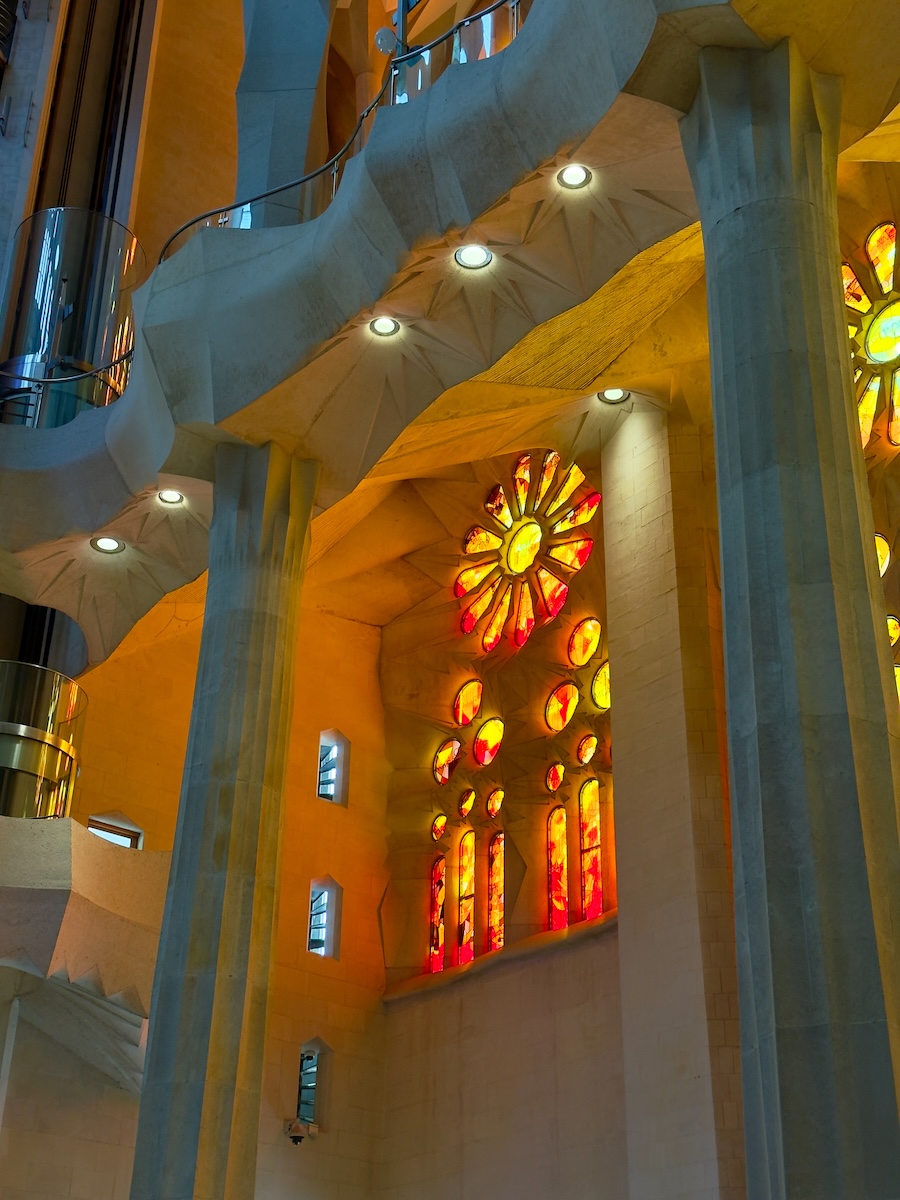
For all the hype, the "tower climb" was mostly a controlled descent—single file, no passing, no stopping. Linger too long for a photo, and the guy behind you will sigh so heavily you can hear his eyes roll. When we finally spilled out at ground level, the light hit differently. Again. Afternoon had set in, and the glass now burned orange. I stood in the nave a while longer, watching color climb the columns until it reached the ceiling and dissolved.19 That felt like my cue to leave.
Three visits, three different experiences—the whirlwind of the tour, the slow exterior with Krista, the quiet solo wander after the tower. The Sagrada isn't something you check off a list. It's a building that changes with the hour, the weather, the crowd, and you. Someday, the Glory façade might be finished. The cranes might come down. Or maybe they'll stay—punctuation marks in a sentence that was never meant to end. But if they do, I hope Krista’s there to see it, preferably on two feet.
It’s strange to think the whole thing began as a modest parish project in 1882, designed by another architect, Francisco de Paula del Villar, in a perfectly respectable Gothic style. Gaudí took it over a year later, tossed the blueprints, and started again—something organic, mathematical, and defiantly spiritual. By the last decade of his life, he was living on-site, attending daily Mass, sleeping in a tiny room, and looking more prophet than architect. When a tram struck him in 1926, the hospital staff mistook him for a beggar. Three days later, he was gone—buried in the crypt below the nave.
A decade later, during the Spanish Civil War, anti-clerical protesters torched his workshop, destroying most of his drawings and plaster models. What’s being built now is part reconstruction, part resurrection—pieced together from fragments, photographs, and digital scans. Every column, every carving, is funded by ticket sales and donations. No corporate sponsors. No government bailout. Just persistence, geometry, and a little divine audacity.
Gaudí liked to say, “My client is not in a hurry.” A century on, it still reads like the most accurate project timeline ever written.
Write a comment