

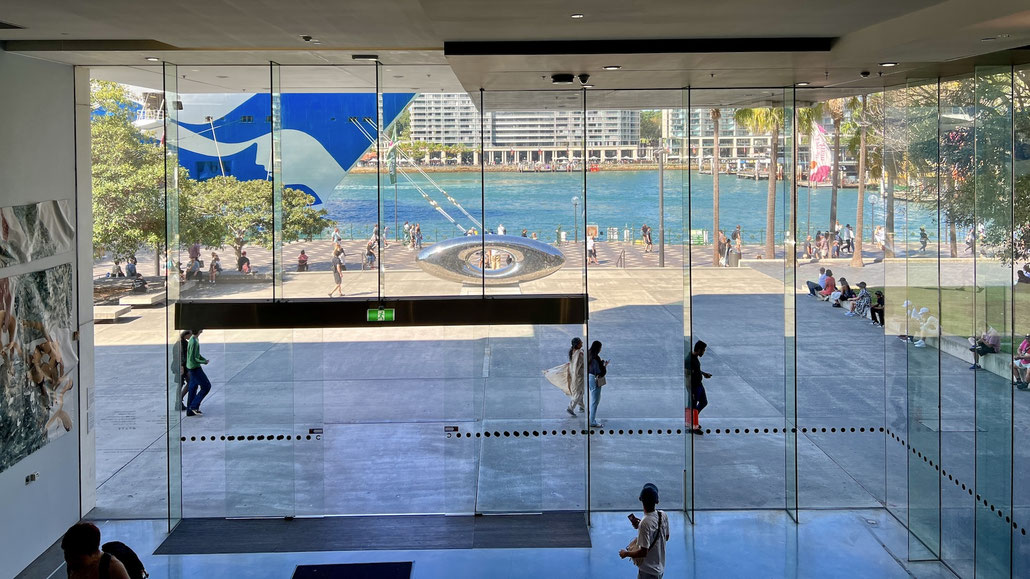
Standing on the edge of Circular Quay, the Museum of Contemporary Art Australia shares its real estate with ferries, joggers, and some of the most played-out views in the country. The building is half sandstone bureaucrat, half glass-and-steel idealist—a combination that makes more sense once you step inside.
The galleries open onto light and noise rather than hush and reverence. The MCA’s collection sprawls across every medium imaginable—painting, sculpture, photography, installation, and the occasional “what exactly is that?” moment. Its mission is simple enough. Show Australia to itself, contradictions included.
Highlights


Mawa I–II, IV–V, 2010 – Alick Tipoti
Four sculptural masks carved from turtle shell, each tied to Torres Strait men’s ceremonial knowledge. Their size startles. Their purpose is deliberately withheld—a quiet reminder that not every story is meant for outsiders.
Remember Us, 2023 – Reko Rennie
A memorial to Aboriginal people who have died in police custody since the 1991 Royal Commission. Bright, blunt, and angry. Thirty years on, the statistics haven’t changed much, which is the point.


Kiacatoo, 1988 – Kevin Gilbert
Gilbert’s poem-painting carries colonial violence in the rhythm of a bush ballad. The rhyme is bait; the subject is massacre. His neighboring pieces extend the same restrained fury, forcing poetry to testify.
Colonising Species, 1989 – Kevin Gilbert
Another of Gilbert’s works on the tension between land and authority. He casts colonial animals as metaphors for invasive power—sharp, sardonic, and weary all at once.


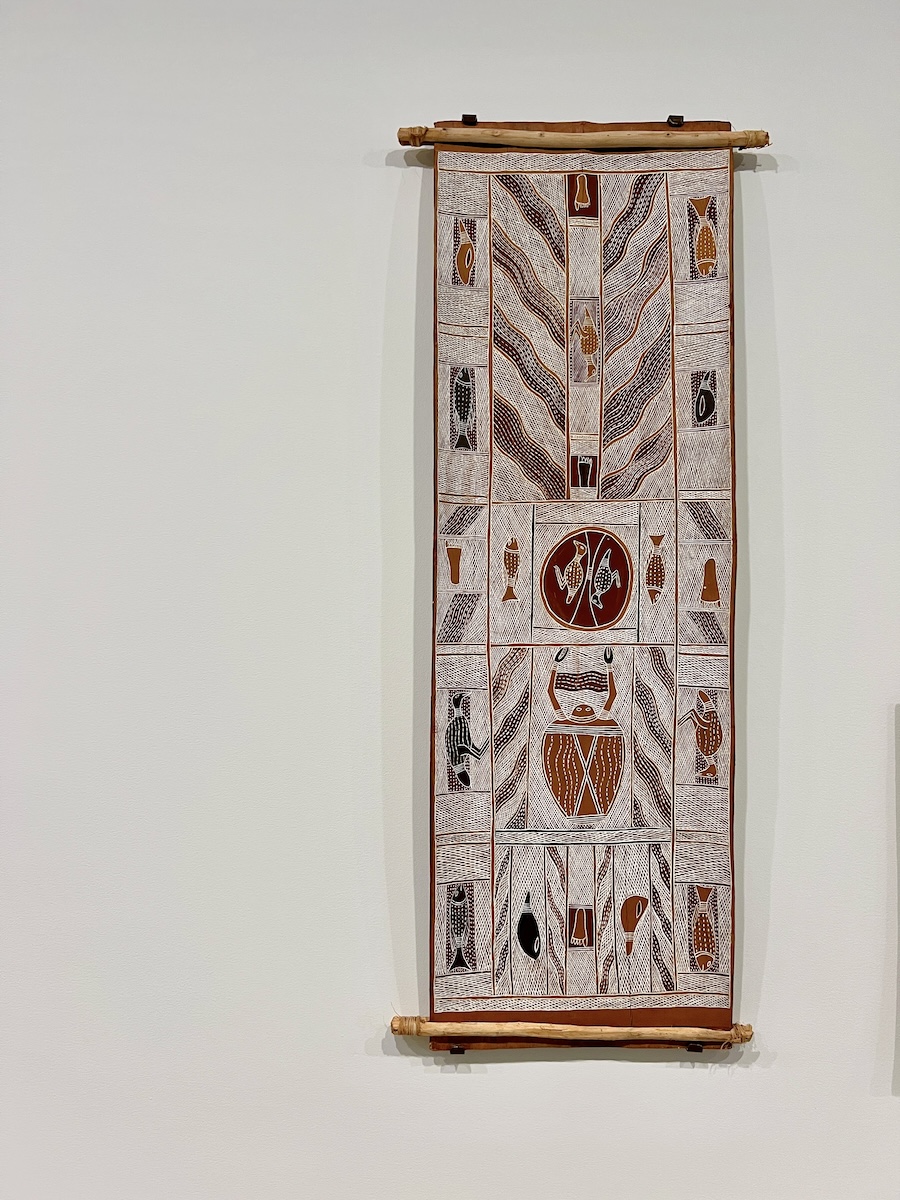
Yingarna, yibarungkwa, viburada, and dungkwiyaya, c1950s – Thomas Nanjiwarra Amagula
Four carved forms—snakes, fish, and kangaroos—that chart ancestral movement across sea and land. Amagula folds story, ecology, and ceremony into one continuous surface.
Gunyan the Crab on the Beach at Djarrakpi, c1970s – Narritjin Maymuru
A Yolŋu artist’s meditation on coastal life and creation. Maymuru’s carved crab isn’t decorative but ancestral, representing the links between marine harvest and sacred knowledge.


kul/karambu, 2020–2021 – Sancintya Mohini Simpson
Resin and pigment glimmer until you learn what they hold. Simpson draws a line between her family’s history on South African sugar plantations and the exploitation of South Sea Islanders in Australia’s north. Beautiful work, but quietly brutal.
Antara nanas and duri (Between the pineapple and the thorns), 2019; Aku (I), 2019
– both Jumaadi
Paired paintings inspired by exiled Indonesian poets in Boven Digul and Cowra. Jumaadi translates displacement and repression into delicate brushwork—melancholy scenes threaded with small acts of defiance and endurance.


Maria’s Garden, 2021 – Simryn Gill
A full-scale print of a neighbor’s demolished backyard in Marrickville, recorded leaf by leaf before the bulldozers arrived. At first glance decorative, it’s actually an archive of care—tender, forensic, and uncomfortably final.
First Jobs, 2008 – Tracey Moffatt
Moffatt turns personal history into cultural record. One series revisits her teenage jobs; the other honors Olympic athletes who finished just outside medal range. Both transform near misses into quiet triumphs without losing the humor.


Ten Thousand Suns—24th Bienniale of Sydney


Black Thursday, February 6th, 1851 – William Strutt
Strutt’s epic bushfire scene shows a colony in panic after Indigenous fire practices were outlawed. The painting is melodramatic, but the fear feels earned. Flames lick at livestock, settlers, and the myth of control itself.
Between this World & the Next, 2023–2024 – Serwah Attafuah
Responding to Strutt's Black Thursday, (above), Serwah Attafuah's digital creation unfolds in a near-future Ghana, an Afrofuturistic vista contrasting colonial remnants with utopian hope. Burning slave castles, sinking colonial ships, and formidable female warriors weave a tale both haunting and empowering.


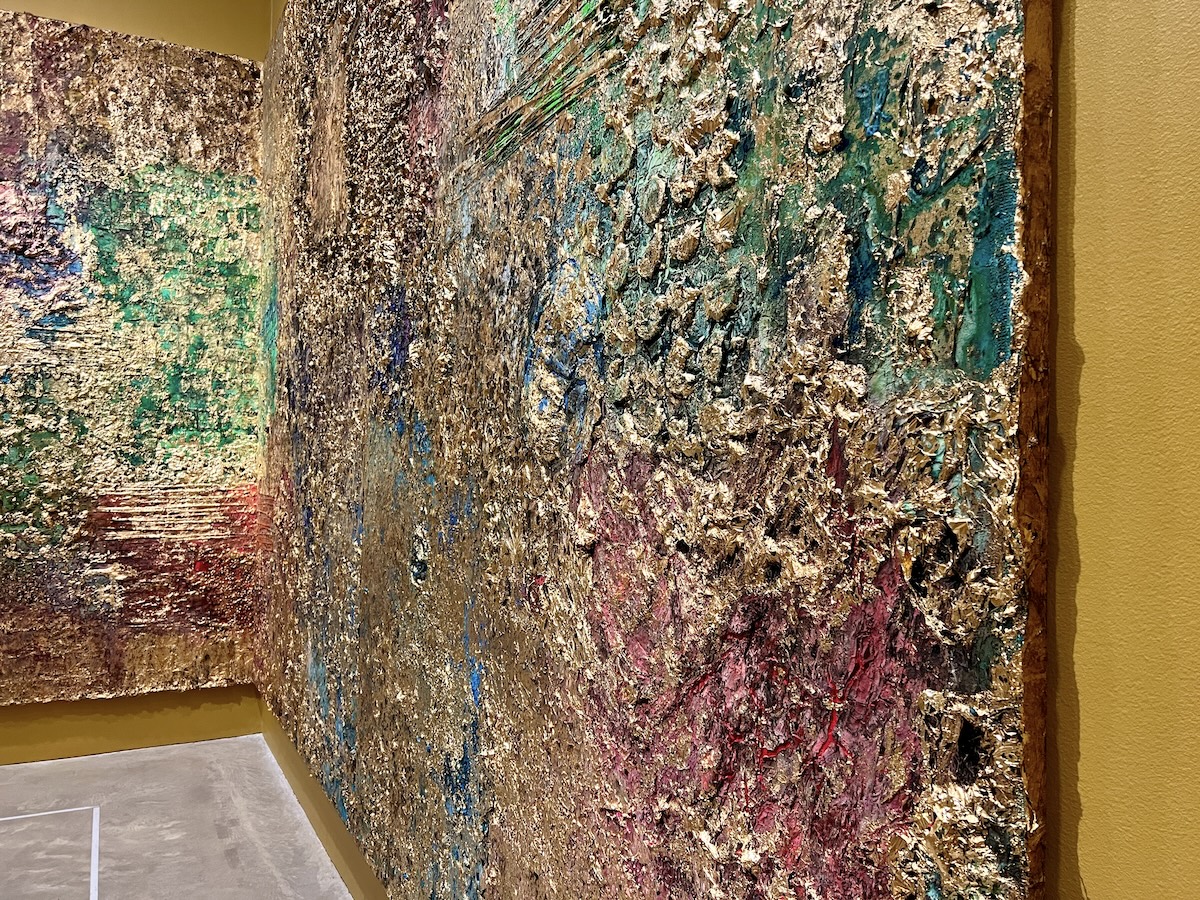
The illusion of your history, 2023 – Kirtika Kain
Sculpture and printmaking merge in Kain’s meditation on Dalit identity. Layers of pigment and wax evoke centuries of erasure and survival. It’s a work that refuses simplification, shimmering between pain and pride.
Aboriginal Camp at Sunset, 1988 – Robert Campbell Jr
A gathering the night before the First Fleet’s arrival. For readers outside Australia, that’s the moment colonization begins. Campbell paints it with warmth instead of grief, which makes it harder to shake.


Cannot Be Broken and Won't Live Unspoken #2, 2023 – Anne Samat
Totemic weavings built from thread, rakes, toy swords, and combs. Samat’s hybrid monuments are equal parts devotion and defiance—handmade proof that love and resistance can share the same material.
The MCA doesn’t pretend to compete with the MoMA or the Tate. It’s smaller, scrappier, and far more interested in who Australia is right now than in who the rest of the world thinks it should be. You won’t love everything, which is fine. The point seems to be the conversation that happens between pieces, and between people standing in front of them.
By the time we left, the afternoon light turned the sandstone gold again. The museum’s glass façade mirrored back the water, the bridge, and a few confused seagulls. Not a bad summary of contemporary art in Australia—reflective, argumentative, and occasionally interrupted by squawking birds.
Write a comment